

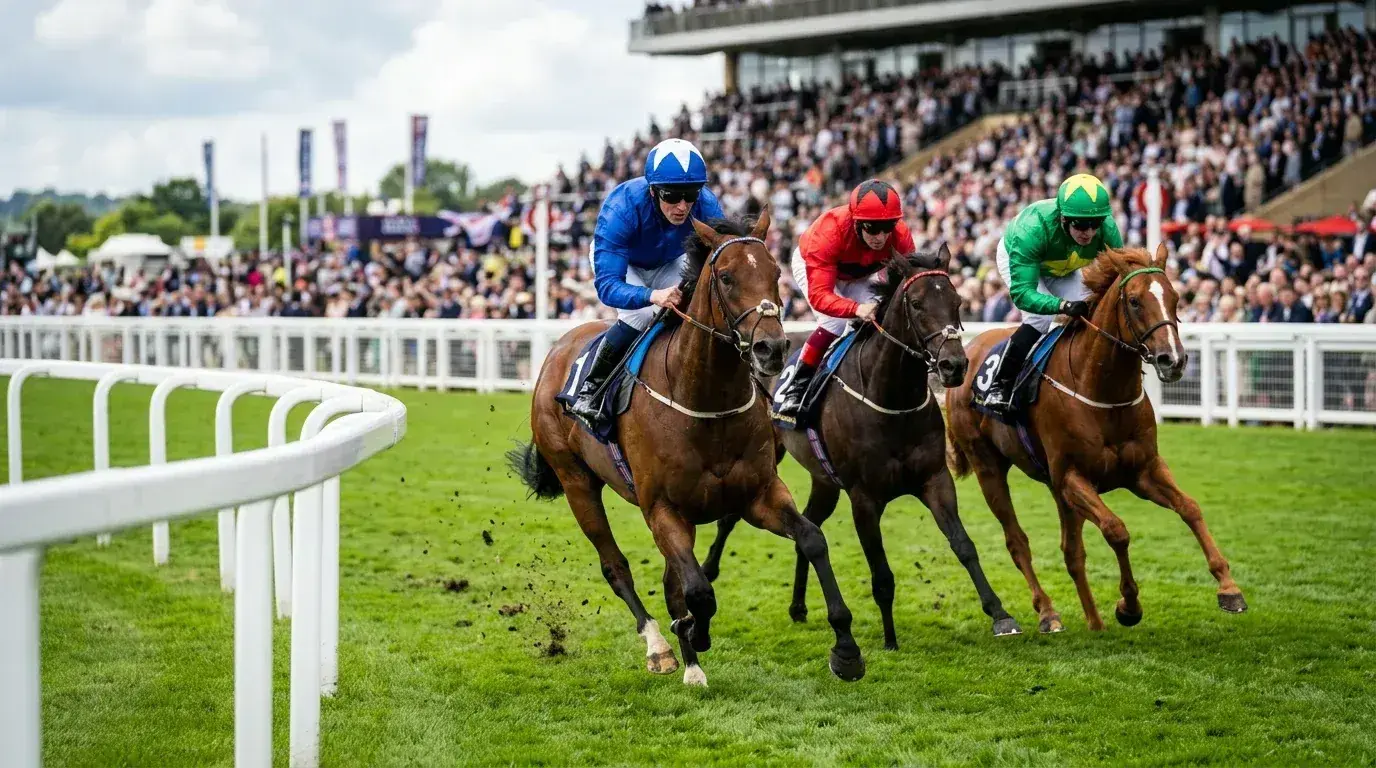
Betsonhorseracing: UK Market Overview
Nine years of analysing horse racing markets have taught me one uncomfortable truth: most punters lose not because they pick the wrong horses, but because they never understand the machinery behind their bets. The UK horse racing betting market generated £766.7 million in gross gaming yield between April 2024 and March 2025, making it the second-largest remote betting vertical after football's £1.3 billion. That is an enormous amount of money flowing through a system most bettors engage with on instinct alone.
This guide exists because the gap between what the industry knows and what punters know has never been wider. Affordability checks now trigger at just £150 in net monthly deposits. Betting turnover has fallen 10.3% over two years. Exchange volumes have collapsed by 59%. Racecourse attendance, meanwhile, crossed 5.031 million in 2025 — the first time above five million since 2019. The market is pulling in two directions at once, and understanding both forces is the difference between punting with your eyes open and punting blind.
I have structured this guide around the questions that actually matter when you place a bet on a horse race in Britain. Not which bookmaker has the shiniest app or the fattest welcome bonus, but how the betting ecosystem works, what each bet type genuinely costs you, and where the data points toward value. Whether you are placing your first each-way on the Grand National or refining a staking plan across a full Flat season, the numbers and principles here apply.
£766.7m
Gross gaming yield from remote horse racing betting in the UK, April 2024 to March 2025
4%
Share of UK adults who bet on horse racing in any four-week period
£150
Monthly net deposit threshold that triggers enhanced affordability checks
5.031m
Racecourse attendance in 2025 — first time above five million since pre-pandemic levels
What follows is not a bookmaker ranking or a tipster column. It is a working manual built on Gambling Commission data, BHA racing reports, and close to a decade of watching this market shift beneath punters' feet. I will walk you through bet mechanics with real calculations, explain the regulatory forces reshaping the landscape, and lay out principles for a betting approach that respects both your bankroll and your time.
What Every UK Punter Should Know Before Placing a Bet
- UK horse racing betting generated £766.7 million in gross gaming yield in the most recent reporting period, but total turnover has dropped 10.3% over two years — the market is contracting under regulatory pressure.
- Win bets dominate at 36% of all wagers, each-way at 22%. Understanding the maths behind each type — particularly how each-way value changes with odds and field size — is the single biggest knowledge gap among regular punters.
- Best Odds Guaranteed is the most valuable bookmaker feature for racing. Using multiple accounts to compare prices and access different BOG windows compounds into real returns over a season.
- Affordability checks now trigger at £150 in monthly net deposits. Adapting your deposit patterns and bankroll management to this threshold is a practical necessity, not a choice.
- Flat and National Hunt racing require fundamentally different betting approaches. Specialising in one code and depth-diving form produces better long-term results than spreading attention across both.
How UK Horse Racing Betting Works in 2026
I remember the first time a friend asked me to explain how horse racing betting "actually works." He had placed dozens of Grand National bets over the years but could not tell me whether his bookmaker was regulated, what happened to the margin on his odds, or why his account had suddenly been restricted. He is not unusual. The system that processes billions in wagers each year runs on principles most punters never examine.
Every licensed bookmaker operating in Britain holds a permit from the UK Gambling Commission under the Gambling Act 2005. That licence is not decorative — it dictates how operators handle your funds, resolve disputes, verify your identity, and report suspicious activity. The total remote betting sector, covering all sports, produced £2.6 billion in gross gaming yield over the most recent reporting period, with horse racing's £766.7 million slice sitting firmly in second place behind football. Add in remote casino and bingo, and the entire regulated online gambling sector reached £7.8 billion in GGY.
Gross Gaming Yield (GGY) — the amount retained by bookmakers after paying out winning bets. It represents what the industry earns, not what punters stake. Total turnover — the sum of all bets placed — is a much larger number.
The relationship between racing and betting in Britain carries a weight that no other sport matches. A European Commission ruling once described it as "a unique interdependency that goes back over 200 years." That is not hyperbole. The Horserace Betting Levy — a statutory charge on bookmaker profits from racing — funds prize money, veterinary science, and integrity services. When betting turnover falls, the sport's infrastructure feels it directly. When racecourses invest in better fixtures, turnover responds. The two are locked together in a way that football, tennis, and every other betting sport simply are not.
UKGC licensing in practice: A licence requires operators to segregate customer funds, provide self-exclusion tools, display responsible gambling messaging, and submit to regular compliance audits. It does not guarantee fair odds, competitive pricing, or that your account will not be restricted. Licensing protects your deposits, not your edge.
Remote betting — any wager placed online, via a mobile app, or by telephone, as distinct from bets placed at a physical betting shop or on-course with a racecourse bookmaker.
Participation figures tell their own story. Roughly 48% of UK adults engage in some form of gambling over any four-week period, though that drops to 27% once you strip out the National Lottery. Horse racing specifically accounts for about 4% participation — a number that fluctuates seasonally, spiking around Cheltenham and the Grand National before settling back. And 95% of online gambling happens at home, which means the vast majority of racing bets are placed from a sofa, not a grandstand.
Fixed odds — the price agreed at the moment you place your bet, locked in regardless of how the market moves before the race. This is the dominant format in British racing, accounting for roughly 95% of all horse racing wagers. The alternative — pari-mutuel or pool betting, run through the Tote — divides the total pool among winning tickets after the race, meaning your return is not known until the dividend is declared.
Understanding these basics matters because every decision you make — which bookmaker to use, when to take a price, whether to bet fixed odds or pool — sits inside this framework. The market is regulated, heavily taxed, and structurally tied to the sport it serves.
Bankroll Burner
The Main Bet Types and How Returns Are Calculated
A colleague once told me that the average punter uses three bet types across an entire racing career: win, each-way, and the occasional accumulator on a Saturday afternoon. He was not being dismissive — he was pointing out that most people never calculate what those bets actually cost them. Win bets dominate the market at 36% of all horse racing wagers. Each-way accounts for 22%, with forecasts and tricasts taking 17% and multiples rounding things out at 10%. Those percentages matter because each type carries a different structural cost, and knowing where the margin hits hardest shapes everything from bet selection to staking.
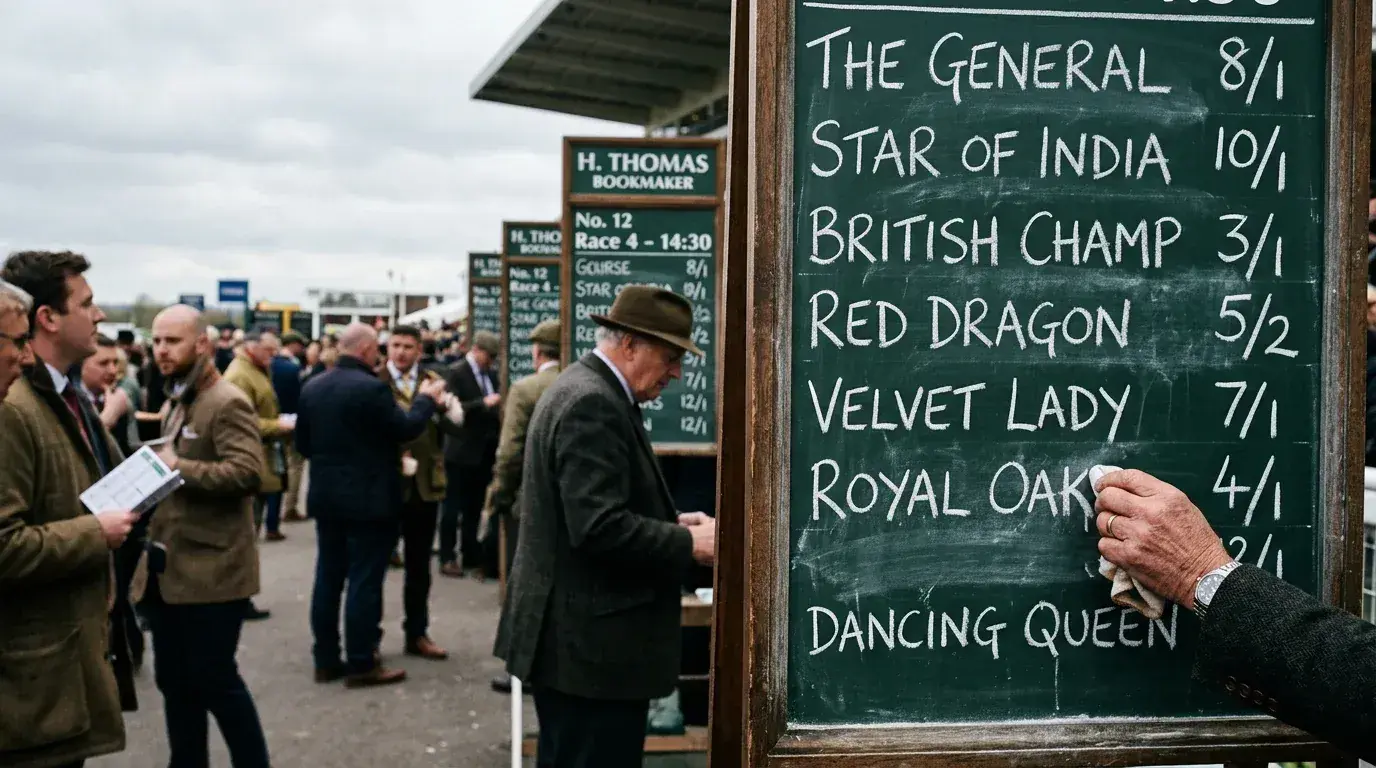
Each-way — a two-part bet combining a win stake and a place stake on the same selection. If your horse wins, both parts pay out. If it finishes in a place position (typically second or third, depending on field size), the place part pays at a fraction of the win odds.
Win, Place and Each-Way
A win bet is the simplest wager in racing: pick a horse, choose your stake, and collect if it finishes first. The return is your stake multiplied by the fractional odds, plus your original stake back. At 5/1, a £10 bet returns £60 — £50 profit plus your £10 stake.
Win bet calculation
Odds: 5/1
Stake: £10
Return if horse wins: (5 x £10) + £10 = £60
Profit: £50
A place bet on its own pays out if your horse finishes within the place terms — usually the top two in fields of five to seven runners, the top three in fields of eight or more, and the top four in handicaps with sixteen-plus runners. The odds are a fraction of the win price, typically a quarter or a fifth depending on the race type.
Each-way combines both into a single bet at double the stated stake. You are placing two equal bets: one on the win, one on the place. The maths requires you to calculate each leg separately. If your horse wins, you collect the full win odds on half your total stake and the place odds on the other half. If it places without winning, you lose the win portion but collect the place return.
Each-way bet calculation — horse places but does not win
Odds: 8/1, place terms 1/4 odds
Stake: £10 each-way (total outlay £20)
Win part: loses (£10 lost)
Place part: (8/4 x £10) + £10 = £30
Total return: £30 from a £20 outlay
Profit: £10
The subtlety most punters miss is that each-way is not always better than a straight win bet. On short-priced favourites, the place return barely covers your total stake, making the each-way element a drag on value. Where each-way shines is at longer odds in large fields, where the place leg can return a profit even when the win leg loses. I have written a detailed breakdown of each-way maths and when it genuinely pays for those who want to run the numbers properly.
Multiples: Doubles, Trebles and Accumulators
Multiples link two or more selections into a single bet, with the returns from each leg rolling into the next. A double covers two selections, a treble covers three, and an accumulator (or "acca") covers four or more. The appeal is obvious: small stakes can produce enormous returns. The catch is equally obvious: every selection must win, and the probability of that happening drops off a cliff with each additional leg.
Consider a four-fold accumulator with each leg priced at 2/1. The combined odds are not 8/1 — they are 80/1 when you compound the returns. A £5 stake returns £405 if all four win. But the probability of landing all four, assuming the odds are a fair reflection of each horse's chances, is just over 1.2%. The bookmaker's margin on each leg compounds too, which means the true expected value of most accumulators is significantly negative. They are entertainment bets, and treating them as a strategy is a reliable way to drain a bankroll.
Full-cover bets like Lucky 15, Lucky 31, and Yankees offer a middle ground by including singles, doubles, trebles, and the accumulator in one package. They cost more per unit stake but provide returns even when not every selection wins. A Lucky 15 from four selections contains fifteen separate bets: four singles, six doubles, four trebles, and one four-fold. The cost at £1 per line is £15, but a single winner from the four still generates a return.
Forecast, Tricast and Exotic Wagers
Forecasts and tricasts ask you to predict the exact finishing order of two or three horses respectively. A straight forecast requires your two selections to finish first and second in the order you specify. A reverse forecast covers both possible orders, doubling your stake. A combination forecast across three or more selections covers every possible first-and-second permutation, with the number of bets — and the cost — escalating quickly.
Tricasts extend the principle to the first three finishers in exact order. The payouts can be substantial — I have seen tricasts in large-field handicaps pay three-figure returns from a £1 stake — but the hit rate is correspondingly low. The computer straight forecast (CSF) and computer tricast are calculated by an algorithm after the race rather than at fixed odds, which means your return depends on the starting prices of the placed horses and the number of runners.
These bets occupy 17% of the market for a reason: they offer the highest potential returns per unit stake of any standard bet type. But they are also where the bookmaker's margin is least transparent, since CSF dividends are determined by a formula that punters cannot verify in advance. If you are drawn to forecasts and tricasts, use them selectively in races with clear form hierarchies where you have strong views on the first two or three home.
Choosing a Bookmaker: Features That Affect Your Edge
I spent the first three years of serious punting using a single bookmaker account. It was convenient, familiar, and — as I eventually calculated — costing me roughly 2-3% in missed value on every bet. The moment I opened accounts with multiple operators and started comparing prices, my returns improved without changing a single selection. That is not a sales pitch for any particular firm. It is a structural fact about how the UK betting market works.
The PPC advertising wars tell you how fiercely operators compete for your attention. In February 2026, one major operator captured nearly 38% of paid search clicks in the UK sports betting segment, with the next largest sitting at around 16%. That concentration of marketing spend does not mean those firms offer the best prices — it means they spend the most to acquire customers. Your job is to look past the advertising and compare the features that directly affect your returns.
Four features matter more than any welcome bonus: Best Odds Guaranteed, extra place terms on each-way bets, live streaming coverage, and the competitiveness of early prices. A feature-by-feature comparison of major UK bookmakers reveals meaningful differences across all four, and those differences compound over hundreds of bets into real money.
Best Odds Guaranteed (BOG)
Pays the higher of your price or SP. Timing windows and race-type exclusions vary significantly between operators. Some activate from the morning, others only from a few hours before the off.
Extra Places Each-Way
Extends standard place terms by one or more positions on selected races. Most common on large-field handicaps at major meetings. Frequency and generosity differ markedly.
Live Streaming
Watch races through your betting account. Coverage ranges from most UK meetings to UK-and-Irish to international. Some require a funded account or a placed bet to access.
Early Price Availability
Prices released the evening before or morning of the race. Better early prices give you more time to secure value before the market tightens closer to the off.
Why multiple accounts matter: Running two or three bookmaker accounts is not about chasing bonuses. It lets you take the best available price on any given selection, access different extra-place offers on the same race, and avoid being locked into a single operator's margin. Over a season of regular betting, the cumulative price advantage from comparing odds across just three accounts outweighs any single welcome offer.

Best Odds Guaranteed and Why It Matters
Best Odds Guaranteed — BOG — is the single most valuable feature a bookmaker offers for horse racing, and most punters treat it as a footnote in the terms and conditions. The principle is simple: if you take an early price and the starting price (SP) is higher, your bet is settled at the better price. You lock in a floor and benefit from any upward drift. No other feature gives you an edge with zero additional risk.
BOG mechanics and limitations: BOG applies to fixed-odds win and each-way bets on UK and Irish races. It does not typically cover ante-post markets, international racing, or bets placed through exchanges. Most operators impose caps — either a maximum additional payout or a maximum odds level beyond which BOG does not apply. Some restrict BOG to bets placed after a certain time, often the morning of the race. These limits vary between operators and are rarely advertised prominently.
The practical impact is significant. When you back a horse at 6/1 in the morning and it drifts to 10/1 by the off, BOG means your winning bet pays 10/1 rather than the 6/1 you took. On a £20 stake, that is the difference between £140 and £220 returned — an extra £80 for making the same selection at the same time. Over a season of regular backing, the accumulated BOG upgrades represent a meaningful addition to overall returns, provided you are betting with operators whose timing windows and caps align with your punting habits.
Live Streaming, Cash Out and In-Play Markets
Live streaming transformed how I watch racing. Before bookmaker streams became standard, following afternoon action meant a Racing TV or Sky Sports Racing subscription. Now, most major operators stream UK and Irish racing through their apps, though the funded-account requirements, coverage breadth, and stream quality vary enough to matter.
Cash out lets you close a bet before the race finishes, locking in a profit or cutting a loss based on the live market price. The feature works well in principle but carries a hidden cost: the cash-out price offered is always worse than the theoretical fair value of your position, because the operator builds a margin into the offer. Use it sparingly and never rely on it as a strategy — it is a risk management tool, not a profit centre.
In-play betting on horse racing is more limited than in football or tennis. Most bookmakers suspend betting once the stalls open for Flat races or once the tapes go up for jumps, though exchanges allow in-running trading right through to the finish. The mobile experience of live streaming and in-play features differs substantially between operators, particularly in terms of latency and market depth, making app quality a genuine factor in bookmaker selection for anyone who bets during live races.
The UK Betting Market by the Numbers
The first time I pulled the Gambling Commission's annual data alongside the BHA's quarterly racing reports, I sat staring at the spreadsheet for a good twenty minutes. The numbers told a story that no bookmaker's marketing department would ever volunteer. The UK horse racing betting market is shrinking in real terms, and the shrinkage is not evenly distributed — it is hitting certain corners of the market with disproportionate force.
-10.3%
Total betting turnover decline over two years, from 2023 to the end of 2025
-59%
Collapse in exchange betting volumes since affordability checks were introduced, adjusted for inflation
5.031m
Racecourse attendance in 2025, crossing five million for the first time since 2019
Total betting turnover fell 4.3% across 2025 alone. Stretch the window to two years and the cumulative decline reaches 10.3%. The average turnover per race dropped 5.8% year on year. BHA Director of Racing Richard Wayman put it plainly: total betting turnover fell nine per cent compared with the same period in 2024, and while work needs to be done on the racing product itself, a much wider range of factors was contributing to the decline.
The exchange market has been hit hardest of all. Betting exchange volumes have dropped 59% in inflation-adjusted terms since the introduction of enhanced affordability checks. That figure is not a rounding error — it represents a structural shift in how higher-staking punters interact with the market. The exchanges, which once thrived on large-volume trading from sophisticated bettors, have seen their core user base either stop betting, move to unlicensed operators, or reduce stakes to below check thresholds.
Against that bleak backdrop, one number stands out as genuinely positive. Racecourse attendance hit 5.031 million in 2025, a 4.8% increase on the prior year and the first time the figure has crossed five million since before the pandemic. Average attendance per meeting rose 3.6% to 3,526. People want to go racing. They just appear to be betting less when they get there — or betting through channels the official data does not capture.
Roughly 13 million people bet on the Grand National each year — approximately one in three UK adults. The race generates 700% more betting turnover than the Cheltenham Gold Cup, with an estimated £150 million wagered on the single race across UK and Irish operators.
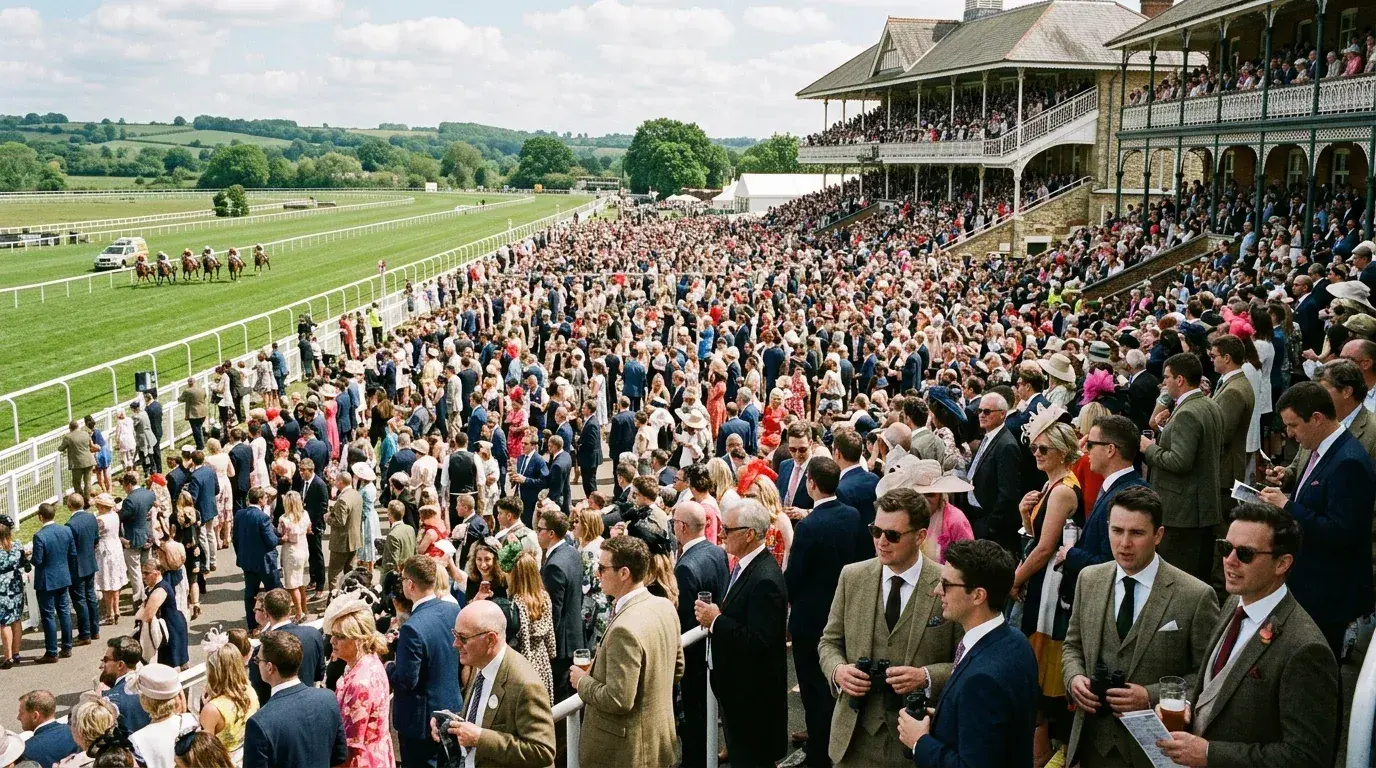
Wayman acknowledged the tension in the BHA's 2025 annual report: the horse population continues to decline and the betting environment remains challenging. The sport is growing its audience through the racecourse gates while losing revenue through its betting tills. That paradox defines the current moment in UK racing, and every punter operates within it whether they follow the macro data or not.
Affordability Checks and What They Mean for Punters
If you have bet on horse racing with any regularity over the past two years, you have almost certainly encountered an affordability check — or know someone who has. Since February 2025, the Gambling Commission has required operators to trigger enhanced checks when a customer's net deposits reach £150 in a calendar month. That threshold, lowered from £500, catches a significant proportion of regular punters who would never consider themselves high-staking.
How the £150 threshold works: Net deposits means deposits minus withdrawals within the month. If you deposit £200 and withdraw £100, your net deposit is £100 — below the threshold. If you deposit £200 and lose it all, your net deposit is £200 and a check may be triggered. The operator can then request payslips, bank statements, or other financial documentation before allowing you to continue betting at the same level.
The policy's intent — preventing gambling harm by ensuring people are not betting beyond their means — is not in dispute. What is fiercely debated is the execution. A survey by the Betting and Gaming Council found that 65% of UK gamblers would refuse to submit financial documents for affordability checks, preferring to stop betting or find alternatives. Richard Wayman at the BHA drew a direct line from checks to market decline: there is no doubt that affordability checks have resulted in people either stopping betting or placing their bets with unlicensed operators, where such checks do not take place.
The preference for bigger meetings over everyday fixtures is another visible consequence. Wayman described it in the Q3 2025 racing report: fewer larger-staking customers remain, having either stopped betting or moved elsewhere, and they have only been partially replaced by more recreational punters betting in smaller stakes, primarily at the bigger meetings. The result is a two-tier market where Cheltenham and the Grand National hold up while midweek fixtures at smaller tracks see turnover drain away.
What triggers a check and what happens next: Enhanced checks can involve requests for proof of income (payslips, tax returns), source of funds documentation, or spending pattern reviews. The process varies by operator — some handle it quickly via automated data checks, others require manual document submission that can freeze your account for days or weeks. The experience is inconsistent across the industry, which adds to punter frustration.
Former Jockey Club Chief Executive Nevin Truesdale framed the concern from the sport's perspective: the Gambling Commission seems to want to reduce gambling to just small-stakes gamblers, and that cannot be right. Meanwhile, 408 industry figures — trainers, owners, jockeys, breeders — signed an open letter to the Culture Secretary requesting a pause on the checks, arguing that the cure was doing more damage than the disease.
The data on where displaced bettors are going is stark. The number of UK customers on unlicensed platforms has surged 522% over three years. One in three punters staking £1,000 or more per transaction reported using an unregulated operator within the past year. These offshore operators pay no tax, contribute nothing to the betting levy that funds the sport, and offer none of the consumer protections that come with UKGC licensing.
Affordability checks are now a permanent feature of UK betting. Whether you agree with them or not, adapting your bankroll management and deposit patterns to work within the £150 monthly net deposit threshold — or being prepared to document your finances if you exceed it — is a practical necessity for any regular punter.
Flat vs National Hunt: Two Codes, Different Betting Approaches
A punter who treats Flat racing and National Hunt as interchangeable is making the same mistake as a football bettor who applies Premier League logic to the Conference. The two codes share a sport but almost nothing else in terms of form interpretation, market behaviour, or where value tends to hide.
Flat racing runs primarily from April to October on turf, with all-weather meetings filling the winter calendar. Races are shorter — from five furlongs to two and a half miles — and decided by raw speed, acceleration, and the jockey's ability to exploit the draw and pace. National Hunt, the jumps code, runs its core season from October through April, with races spanning two to four-plus miles over hurdles or fences. Stamina, jumping ability, and ground conditions dominate outcomes to a degree that Flat specialists sometimes underestimate.
Flat Racing
Season: April to October (turf), year-round (all-weather). Distances: 5 furlongs to 2.5 miles. Key factors: speed, draw bias, going. Major events: Royal Ascot, Epsom Derby, the Guineas. Betting character: faster-moving markets, draw analysis critical in big handicaps, two-year-old form is notoriously unreliable early in the season.
National Hunt
Season: October to April (core). Distances: 2 miles to 4+ miles. Key factors: stamina, jumping record, ground. Major events: Cheltenham Festival, Grand National, King George VI Chase. Betting character: ground conditions shift markets dramatically, novice hurdlers and chasers offer form edges, faller risk adds volatility that odds do not always reflect.
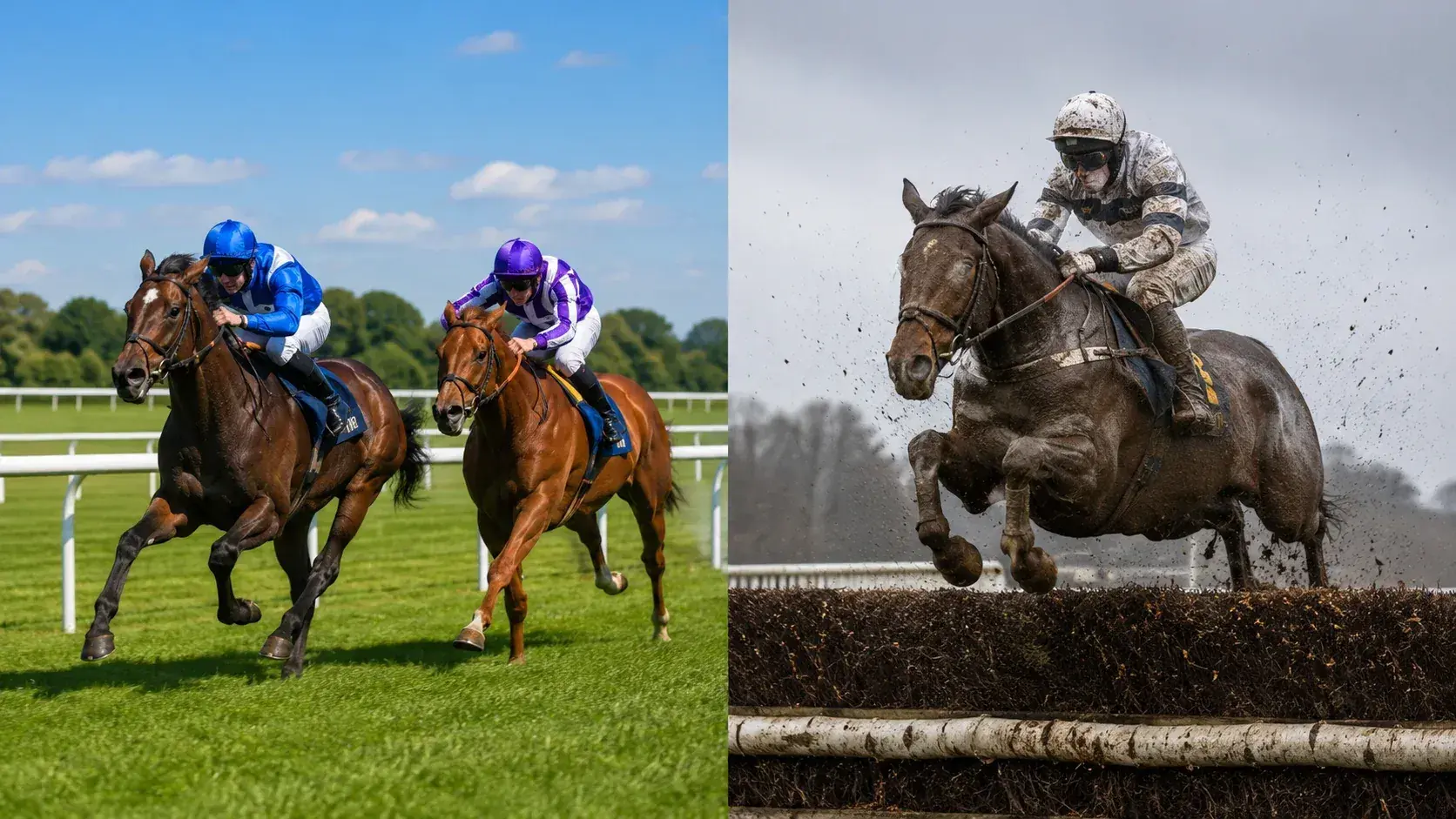
The betting implications run deep. On the Flat, draw bias in big-field handicaps — particularly at courses like Chester and Beverley — can make or break a selection before the race even starts. In jumps racing, a horse's fencing record at a specific course matters more than raw ability; a brilliant stayer who cannot jump Aintree's fences is dead money in the Grand National regardless of the handicap mark.
Ground conditions affect both codes, but the impact is asymmetric. Soft ground on the Flat can turn a well-drawn sprinter into an also-ran. Heavy ground over jumps often eliminates half the field before the race starts — horses with no proven form on soft or heavy going become easy to cross off, narrowing the field in ways that create value for those paying attention. In 2025, 68% of ticket buyers at racecourses were casual or first-time attendees, and many of those punters bet without considering the code-specific factors that shape results. That gap between casual interest and informed analysis is precisely where an edge exists.
I tend to specialise in one code per season and only crossover for the major festivals. Trying to maintain form knowledge across both codes simultaneously, while also following the all-weather calendar, stretches attention thin. If you are building a structured betting strategy, picking your code and depth-diving into it produces better returns than surface-level coverage of everything.
The Racing Calendar: When to Bet and Why It Matters
Three days in March taught me more about market dynamics than three years of daily punting. The Cheltenham Festival compresses the most intense form analysis, the largest betting volumes, and the sharpest bookmaker margins into four days of National Hunt racing. Every other festival — Ascot, Aintree, Glorious Goodwood — has its own rhythm, but Cheltenham is where the money concentrates with enough force to reshape the market around it.
The UK racing calendar is not a flat schedule of equivalent meetings. It is a hierarchy, and the betting market treats it accordingly. Premier fixtures at the major courses attract the deepest liquidity, the most competitive early prices, and the best extra-place offers from bookmakers. Core-fixture meetings on midweek afternoons at smaller tracks see thinner markets, wider margins, and less promotional attention. The BHA's own data confirms this split: in Q1 2025, average turnover on core fixtures fell 14.4% compared with the prior year, while Premier fixture turnover held steady.
The Grand National generates approximately 700% more betting turnover than the Cheltenham Gold Cup. William Hill estimated the race alone attracts around £150 million in wagers across UK and Irish operators, with the full three-day Aintree Festival pushing total turnover toward £250 million.
The major festivals anchor the calendar. Cheltenham in March dominates National Hunt, with the Champion Hurdle, Queen Mother Champion Chase, Stayers' Hurdle, and Gold Cup spread across four days. Aintree follows in April, crowned by the Grand National — a race that roughly 13 million people bet on annually, including millions who never place another wager all year. Former Jockey Club Chief Executive Nevin Truesdale described the National as the main shop window of the sport — a race that needs to be preserved and protected while maintaining its acceptability to society.
On the Flat side, the Guineas at Newmarket opens the Classic season in May, followed by the Epsom Derby in June, Royal Ascot in the same month, Glorious Goodwood in late July, and the St Leger at Doncaster in September. Each has a distinct betting character. Ascot's big-field handicaps reward draw-bias analysis. The Derby's unique downhill camber at Epsom eliminates horses who cannot handle it regardless of ability. Goodwood's undulating course produces shock results that make ante-post betting riskier than at more conventional tracks.
For punters, the calendar dictates when to push and when to conserve. The major festivals are when bookmaker generosity peaks — BOG is universally active, extra places are at their most generous, and the sheer volume of betting means early prices are competitive. Midweek meetings at smaller tracks offer less margin for error but also less market attention, which can mean value for punters who do the form work when others are not paying attention.
Knowing when the big meetings fall is the easy part. Building an approach that survives the weeks and months between them is what separates punters who last from punters who do not.
Building a Sustainable Betting Approach
The most expensive lesson in my nine years of horse racing analysis came in year two: a three-month winning streak followed by a single catastrophic week that wiped out 60% of the profit. I was betting the right horses but managing the bankroll like someone who thought the streak would never end. It always ends. The question is whether your approach survives when it does.
Bankroll management is not glamorous. It will never be the subject of a pub conversation or a social media post. But it is the single variable that separates punters who are still active after five years from those who blew through their funds in six months. The principle is straightforward: allocate a fixed betting bank, stake a consistent percentage per bet, and never chase losses by increasing stakes after a losing run. Flat staking at 1-2% of your total bank per bet is the simplest discipline. Percentage staking — where your stake adjusts up or down as your bank grows or shrinks — is more sophisticated but achieves the same goal: protecting the bank from catastrophic sequences.
Before placing any horse racing bet
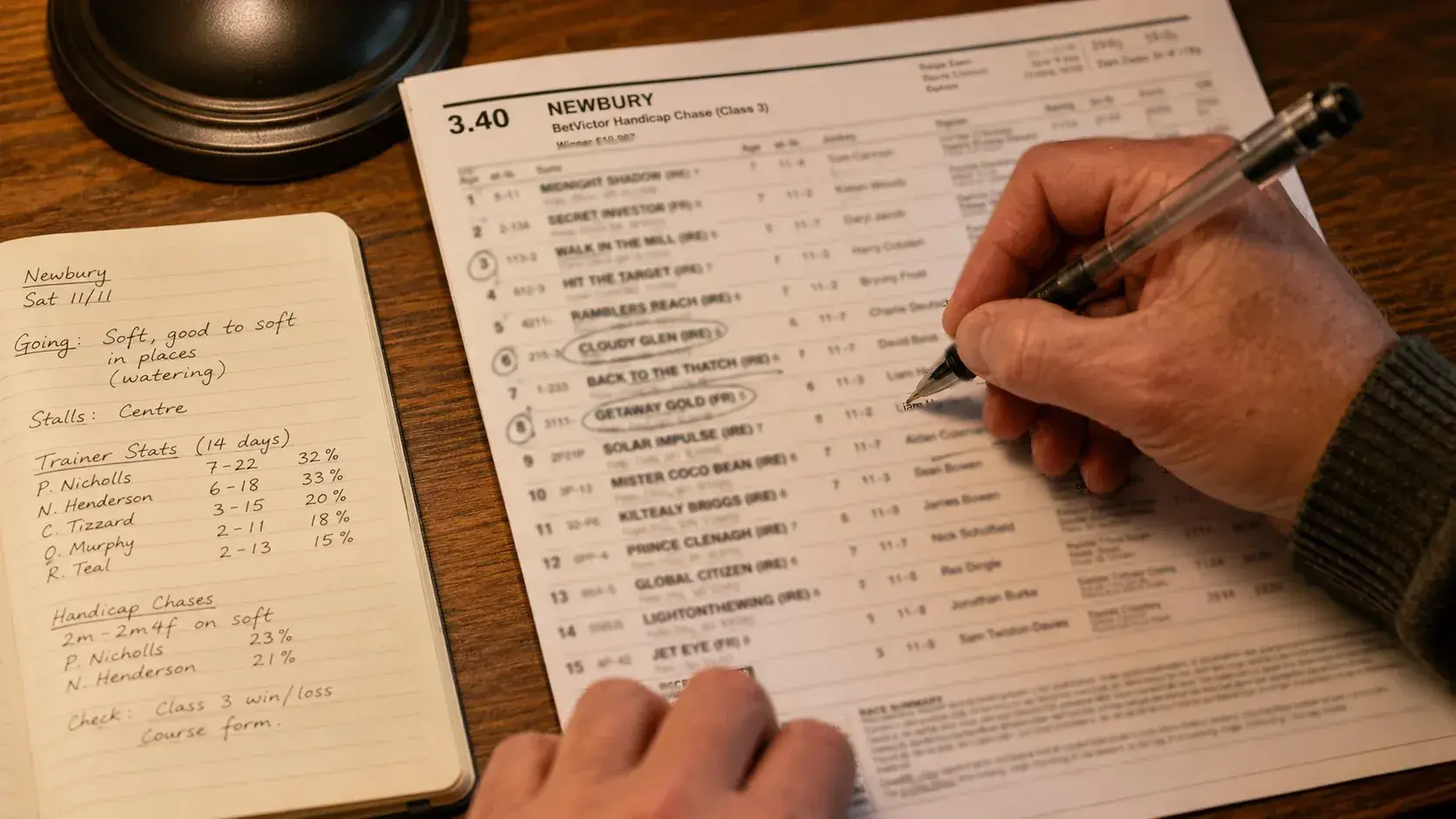
- Check the form: has this horse run well at today's course, over this distance, on this going?
- Check the going: has the ground changed since declarations? Does your selection have proven form on the prevailing surface?
- Check for BOG: is Best Odds Guaranteed active at your bookmaker for this race? If not, consider waiting or switching operators.
- Check your bankroll limit: does this stake sit within your predefined percentage of your betting bank? If you need to increase the stake to "make up" for a previous loss, stop.
- Check the price: have you compared odds across at least two operators? Are you getting the best available price on this selection?
The participation data underlines why discipline matters. Only 4% of UK adults bet on horse racing in any given four-week period, but within that group the gender split is stark — 16% of men bet on sports compared to 4% of women. The typical racing punter is male, bets regularly, and is therefore exposed to the cumulative effects of poor staking discipline over extended periods. A bad afternoon at Cheltenham is a story. A bad season-long staking approach is a financial problem.
Responsible gambling is a practical concern, not a slogan. Set deposit limits with your bookmaker before you start betting, not after you have exceeded a comfortable amount. Use the cooling-off and self-exclusion tools that UKGC-licensed operators are required to provide. If you find yourself betting more than you planned or chasing losses across multiple accounts, the National Gambling Helpline (0808 8020 133) offers free, confidential support.
Value identification completes the picture. A bet has value when the odds offered are higher than the true probability of the horse winning. You will never know that probability with certainty, but you can develop a sense for it through systematic form reading, understanding how odds translate to implied probability, and tracking your own strike rate over time. The punter who backs 50 horses at 4/1 over a season and records 14 winners has found value — 28% winners against implied probability of 20%. The punter who backs 50 horses at 4/1 and records 8 winners has not, regardless of any individual big-priced winner along the way.
Building a sustainable approach means accepting that most individual bets will lose, that winning streaks are temporary, and that the edge — if it exists — only reveals itself over hundreds of bets with consistent staking.
FAQ
What is each-way betting in horse racing and how does it work?
An each-way bet is two bets in one: a win bet and a place bet on the same horse, at equal stakes. If your horse wins, both parts pay out — the win part at full odds and the place part at a fraction of the odds (typically 1/4 or 1/5). If it places without winning, you lose the win stake but collect on the place part. The total cost is double your stated stake, so "£10 each-way" costs £20. Each-way works best at longer odds in large fields, where the place return can deliver a profit even without a win.
What does Best Odds Guaranteed (BOG) mean?
Best Odds Guaranteed is a bookmaker feature that pays you the higher of the price you took or the starting price (SP). If you back a horse at 5/1 in the morning and it drifts to 8/1 by the off, a BOG-offering bookmaker settles your bet at 8/1. It applies to UK and Irish racing with most operators, though timing windows, payout caps, and race-type exclusions vary. BOG does not typically cover ante-post bets, exchange bets, or international races.
How do I read fractional and decimal horse racing odds?
Fractional odds, the traditional UK format, show profit relative to stake. Odds of 5/1 mean £5 profit for every £1 staked, plus your stake back — so a £10 bet returns £60. Decimal odds show total return including stake: fractional 5/1 equals decimal 6.0. To convert, divide the first number by the second and add 1. To find implied probability, divide 1 by the decimal odds — 6.0 implies a 16.7% chance.
What is the difference between Flat racing and National Hunt?
Flat racing involves horses running without obstacles over five furlongs to about two and a half miles, primarily on turf from April to October. Speed and tactical positioning are the dominant factors. National Hunt involves horses jumping hurdles or steeplechase fences over two to four-plus miles, with the core season from October to April. Stamina, jumping ability, and ground conditions carry far more weight. The two codes attract different training methods and different betting dynamics — ground shifts markets more dramatically in National Hunt, while draw bias matters more on the Flat.
What are the most popular types of horse racing bets in the UK?
Win bets account for 36% of the UK horse racing betting market. Each-way follows at 22%, combining a win and place bet on the same selection. Forecasts and tricasts — predicting the first two or three finishers in order — take 17%. Singles account for 15%, and multiples including doubles, trebles, and accumulators make up 10%. Full-cover bets like the Lucky 15 and Yankee are popular for Saturday cards. The Tote offers pool-based alternatives including the Placepot, requiring a placed horse in each of six consecutive races.
How do I choose a horse racing betting site in the UK?
Prioritise features that directly affect returns over marketing. Check whether the operator offers Best Odds Guaranteed and when it activates. Compare extra-place terms on each-way bets for major meetings. Assess live streaming coverage and funded-account requirements. Look at early price competitiveness. Confirm the site is UKGC-licensed for fund protection and dispute resolution. Running two or three accounts lets you take the best available price on any selection rather than being locked into a single operator's margin.
What is the Tote and how does tote betting differ from fixed odds?
The Tote operates a pari-mutuel (pool) system where all stakes on a market are pooled together. After the race, the pool is divided among winning ticket holders minus a deduction for operating costs. Your exact return depends on how much was staked on each horse and is only known when the dividend is declared. Fixed-odds betting locks in your price at the moment of the bet. The Tote Guarantee ensures pool payouts on win bets match or exceed SP, removing the downside risk. The Tote accounts for roughly 5% of UK horse racing wagers, with fixed odds covering the remaining 95%.
