

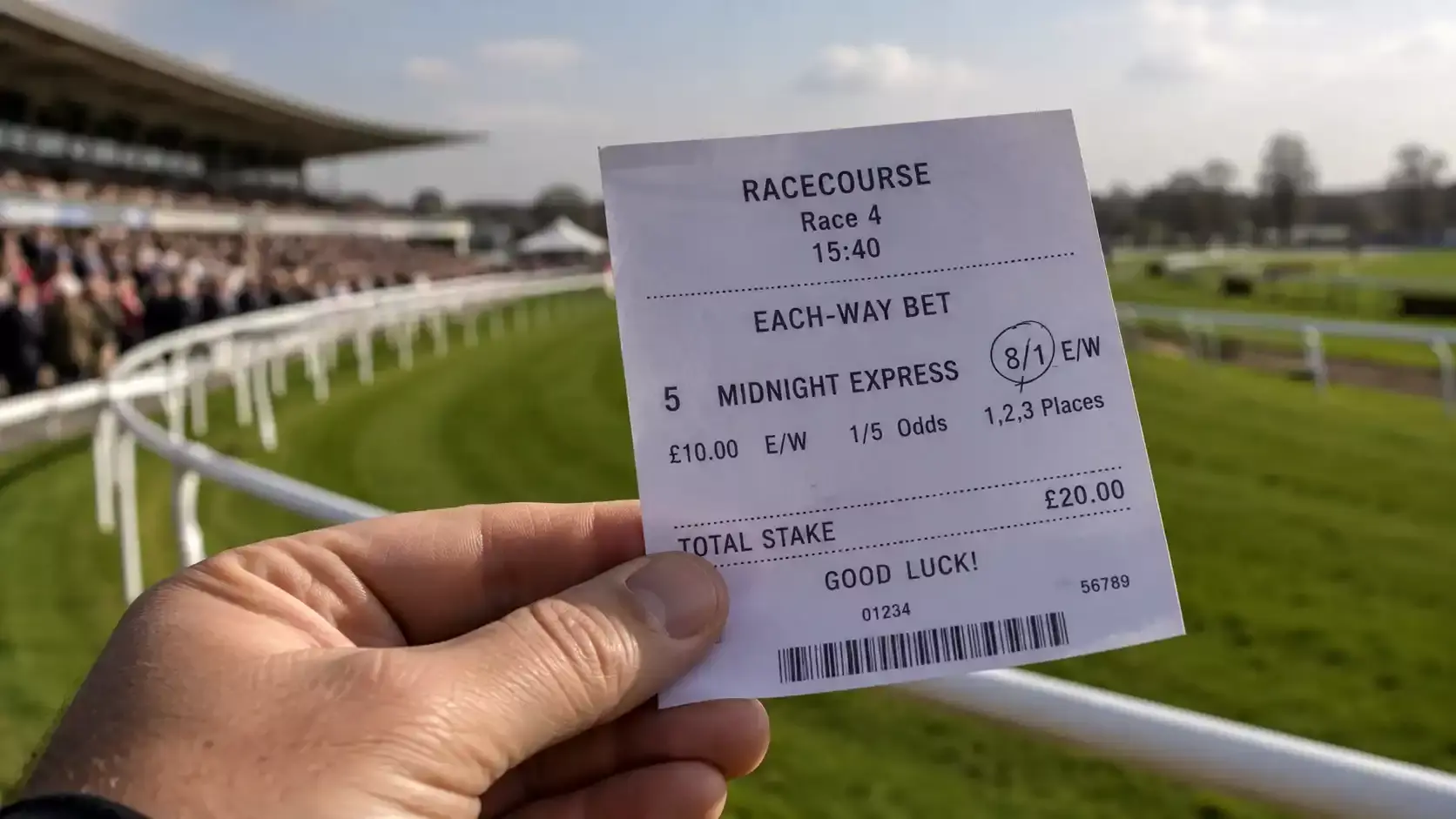
The first each-way bet I ever placed was on a 20/1 shot in a sixteen-runner handicap at Newbury. The horse finished fourth. I thought I had lost. Then my account balance went up. That moment — confusion turning to pleasant surprise — is how most people discover each-way betting, and it is also why so many people misunderstand it.
Each-way is not one bet. It is two. And the maths behind those two bets is more interesting than the industry lets on. Win bets account for 36% of the UK horse racing wagering market, each-way takes 22%, and the rest splits between singles, multiples and exotic wagers like forecasts and tricasts. That 22% represents an enormous amount of money flowing through a bet type where the returns depend not just on odds, but on place terms, field sizes and the specific conditions each operator sets.
This article strips each-way betting down to its mathematical skeleton. I am going to show you exactly how the two wagers work, how place terms change by race type, how to calculate returns step by step, and — most importantly — when each-way genuinely outperforms a straight win bet and when it just doubles your stake for a mediocre return. After nine years of running each-way calculations alongside my selections, I have a clear picture of where the value sits and where it does not.
Before placing a place wager, it is crucial to know how to read horse racing form accurately to spot consistent performers.
Each-Way Bets: How Your Combined Wager Splits
Think of each-way as placing two separate bets on the same horse with the same stake. Your first bet says “this horse will win.” Your second bet says “this horse will finish in a place position.” Place positions are defined by the bookmaker’s terms for that race and typically cover the top two, three or four finishers depending on the field size.
When you place a ten-pound each-way bet, you are spending twenty pounds total. Ten on the win, ten on the place. This is the detail that trips up beginners more than anything else. An “each-way” bet at a tenner is a twenty-pound outlay, not ten. I have seen people get genuinely angry at the betting slip for showing a deduction they were not expecting, simply because the two-bet structure was not clear at the point of selection.
The win part of the bet is straightforward. If your horse wins, you collect at the full odds. A ten-pound win bet at 10/1 returns one hundred pounds in profit plus your ten-pound stake back — one hundred and ten pounds total.
The place part uses a fraction of the win odds. The standard fractions are 1/4 or 1/5 of the odds, depending on the race type. So on that same horse at 10/1 with 1/4 odds place terms, the place part pays at 10/4, which simplifies to 5/2. Your ten-pound place bet at 5/2 returns twenty-five pounds profit plus your ten-pound stake — thirty-five pounds.
If the horse wins, you collect both the win and the place payout. That is the upside scenario. If the horse finishes in a place position but does not win, you lose the win bet but collect the place payout. If the horse finishes outside the places entirely, both bets lose and you are twenty pounds down.
The critical insight is that each-way is not automatically better than a straight win bet. It costs twice as much. If you have twenty pounds to wager, putting it all on the win at 10/1 returns two hundred and twenty pounds if the horse wins. Splitting it ten-pound each-way returns one hundred and forty-five pounds if the horse wins — seventy-five pounds less — but gives you a safety net of thirty-five pounds if the horse places without winning. Whether that safety net is worth seventy-five pounds of upside depends entirely on the probability of each outcome, which is where the maths gets interesting.
The two-bet structure also means you need to think about your selection differently. For a win-only bet, you only care whether the horse finishes first. For each-way, you care about the probability of finishing in the places too. A horse that has a strong chance of finishing second or third but a low chance of winning is a better each-way proposition than a horse that either wins or finishes nowhere. Understanding this distinction is the foundation of everything that follows.
Place Terms by Field Size and Race Type
Every autumn, around the time the big Saturday handicaps start drawing twenty-plus runner fields, I get messages from people asking why their each-way bet on a sixteen-runner race paid three places at one bookmaker and four places at another. The answer is that place terms are not universal — they follow a standard framework but operators can and do vary them.
The standard framework works like this. In races with five to seven runners, bookmakers typically pay two places at 1/4 the odds. Eight or more runners extends it to three places at 1/4 the odds. In handicap races with sixteen or more runners, the standard is four places at 1/4 the odds. Some operators adjust to 1/5 odds on races with large fields where they offer additional places.
Races with four or fewer runners usually do not allow each-way betting at all. If a race drops below five runners due to withdrawals after you have already placed your each-way bet, most operators will void the place part of the bet and settle the win part only. This catch has cost me more than once when a fancied horse was withdrawn on the morning of the race, shrinking the field below the each-way threshold.
The distinction between handicap and non-handicap races matters for place terms. A sixteen-runner conditions stakes race might only pay three places, while a sixteen-runner handicap pays four. The bookmaker’s logic is that handicap races produce more competitive fields and tighter finishes, so the additional place position reflects the increased difficulty of picking the first three in order of merit.
Overall turnover on UK racing fell 9% in the first quarter of 2025 compared with the same period in 2024, and average turnover per core fixture dropped 14.4%. That decline has shifted the competitive dynamics around place terms. Operators competing for a shrinking pool of active bettors have responded partly by enhancing their each-way terms on premium fixtures — offering five or six places on major handicaps where the standard would be four. This is good news for punters who pay attention to which operators are running enhanced terms on specific races.
Festival meetings have their own place-term conventions. At Cheltenham, some bookmakers pay extra places on every race during the four-day festival. The Grand National, with its field of up to forty runners, typically pays six or even seven places depending on the operator. Royal Ascot’s big handicaps regularly attract extra-place promotions from multiple bookmakers. These enhanced terms at major meetings are worth planning around because the difference between three places and five or six places in a twenty-plus-runner field is substantial.
The practical takeaway: always check the specific place terms before placing an each-way bet. Do not assume they are the same across operators or even the same at one operator from race to race. The terms are displayed on the racecard page of every bookmaker site, usually next to the odds. It takes five seconds to check and can determine whether your each-way bet represents good value or a poor use of your stake.
Calculating Each-Way Returns Step by Step
I keep a calculator on my desk specifically for each-way returns. Not because the maths is difficult — it is not — but because doing it by hand forces me to think about whether the bet is actually worth placing. Here is how the calculation works, broken down into the simplest possible steps.
Start with your stake and the odds. Say you place a five-pound each-way bet on a horse at 12/1 in a ten-runner race with standard terms of three places at 1/4 the odds. Your total outlay is ten pounds — five on the win, five on the place.
Calculate the win return first. Five pounds at 12/1 gives you sixty pounds in profit. Add back your five-pound stake for a total win return of sixty-five pounds.
Now calculate the place return. Take the odds of 12/1 and divide by four to get the place odds: 12/4 = 3/1. Five pounds at 3/1 gives you fifteen pounds in profit. Add back your five-pound stake for a total place return of twenty pounds.
If the horse wins, you collect both: sixty-five plus twenty equals eighty-five pounds total. Subtract your ten-pound outlay and your profit is seventy-five pounds.
If the horse finishes second or third, you lose the five-pound win bet but collect the place return of twenty pounds. Your net result is twenty minus ten (total outlay) equals a ten-pound profit.
If the horse finishes fourth or worse, you lose both bets. Your loss is ten pounds.
Now let us run the same calculation with a different set of odds to see how the dynamics shift. Take a horse at 3/1 in the same ten-runner race, five pounds each-way. Total outlay: ten pounds. Win return: five at 3/1 = fifteen plus five = twenty pounds. Place return: 3/1 divided by 4 = 3/4. Five pounds at 3/4 = three pounds seventy-five in profit plus five-pound stake = eight pounds seventy-five. If the horse wins, total return is twenty plus eight pounds seventy-five = twenty-eight pounds seventy-five, for a profit of eighteen seventy-five. If the horse places, return is eight seventy-five minus ten outlay, giving you a loss of one pound twenty-five.
That second example reveals a crucial pattern. At short odds, the place part of an each-way bet often returns less than your total outlay if the horse places but does not win. You end up with a net loss even when your horse finishes in the frame. This is why each-way betting at short prices is almost always a poor strategy — the place fraction of already-short odds produces returns that do not cover the combined stake.
The crossover point varies by place terms and field size, but as a general guide, each-way starts to make mathematical sense at odds of around 5/1 or higher with 1/4 place terms. Below 5/1, the place return frequently fails to cover the total outlay on a place-only result, which means you need the horse to win outright to make money — in which case, why not just back it to win and save the place stake?
For 1/5 place terms, the crossover moves higher. You need odds of roughly 7/1 or more before the place return covers the combined outlay on a place-only result. Always do the calculation before placing the bet. If the place return on its own does not at least break even against your total stake, each-way is costing you money every time the horse places but does not win.
When Each-Way Beats a Straight Win Bet
A friend of mine backed the same horse at the Cheltenham Festival two different ways: twenty pounds to win at one bookmaker and ten pounds each-way at another. The horse finished third. His win bet returned nothing. His each-way bet returned a profit. He told me the each-way was obviously the better bet. I told him to look at what would have happened if the horse had won.
That scenario captures the trade-off perfectly. Each-way betting sacrifices upside for downside protection. Whether that trade is worth making depends on three things: the odds, the probability of placing, and the number of place positions on offer.
Richard Wayman, Director of Racing at the BHA, has pointed out that the shift towards recreational punters betting in smaller stakes at bigger meetings is linked partly to affordability checks reducing the number of larger-staking customers. This trend matters for each-way analysis because recreational punters disproportionately favour each-way bets — the safety net of a place return appeals to those betting for entertainment rather than edge. But whether that safety net represents good value is a separate question entirely.
Each-way outperforms a straight win bet in a specific set of circumstances. The horse needs to be at odds of roughly 5/1 or higher. The race needs enough runners to offer meaningful place terms — ideally twelve or more for three or four places. And the horse’s profile should suggest it is more likely to place than the market implies. A consistent horse that rarely wins but frequently finishes in the top three is a classic each-way type. A horse that either bolts up or trails in last is not.
The probability dimension is where most punters go wrong. Each-way does not automatically add value just because the odds are long. A 25/1 outsider with almost no realistic chance of finishing in the first four is a bad each-way bet because the place probability is too low to justify the doubled stake. A 10/1 shot in a competitive sixteen-runner handicap, where you assess its chance of placing in the first four at around 30%, is a much stronger each-way candidate because the place return has a meaningful probability of landing.
I apply a rough filter. If I would bet ten pounds to win, I ask: would I pay an additional ten pounds for a 30% chance of getting roughly twenty-five pounds back? If the answer is yes, each-way makes sense. If the place probability is below 25%, or the place return barely covers the outlay, I stick to win-only and accept the binary outcome.
Participation in horse racing betting stood at just 4% of UK adults over the four weeks to October 2025 — a seasonal dip from 7% earlier in the year. Within that relatively small active population, the split between win-only and each-way bettors reflects a genuine strategic divide. The win-only camp maximises upside. The each-way camp smooths the variance. Neither is universally correct, but understanding when each approach has the mathematical edge is the difference between betting with a framework and betting on instinct.
Extra Places: How Bookmakers Extend Each-Way Value
William Hill’s dominance in PPC spending — capturing nearly 38% of clicks in the UK sports betting segment — tells you where operators are investing to attract customers. Extra place offers sit right at the centre of that competition. When one operator advertises six places each-way on the Grand National while the standard is four, that is not generosity. It is a calculated move to attract volume, and it happens to benefit the punter.
Extra-place offers extend the standard place terms on selected races. A race that normally pays three places might pay four or five. A big handicap that normally pays four might pay six. The additional positions create scenarios where horses that would have finished just outside the standard places now deliver a return. For each-way bettors, this is free value — the odds remain the same, the fraction remains the same, but the number of outcomes that produce a payout increases.
The catch, as always, is in the details. Some operators offer extra places but adjust the odds fraction downward. A race that normally pays at 1/4 the odds for three places might offer five places at 1/5 the odds. That reduction in the place fraction partially offsets the benefit of the additional places, and in some cases, particularly on shorter-priced horses, the net effect is minimal. Always compare the total expected return under both sets of terms — standard places at the standard fraction versus extra places at a potentially reduced fraction.
I track extra-place outcomes separately in my betting records. Over the past two seasons, I have had eleven horses finish in an extra-place position that would have been a loser under standard terms. The total recovered from those eleven results was just over three hundred pounds on relatively modest stakes. That is money I would have lost without the enhanced terms, and it required no additional skill — just the habit of checking which operator was offering the best place terms on each race.
The principle behind extra places extends to combination bets too. A Lucky 15, for example, multiplies the impact of each-way value across four selections — and when extra-place terms apply to even one leg, the uplift compounds through the multiples.
Find the most reliable data and wagering tips at the premier UK horse racing betting site.
