

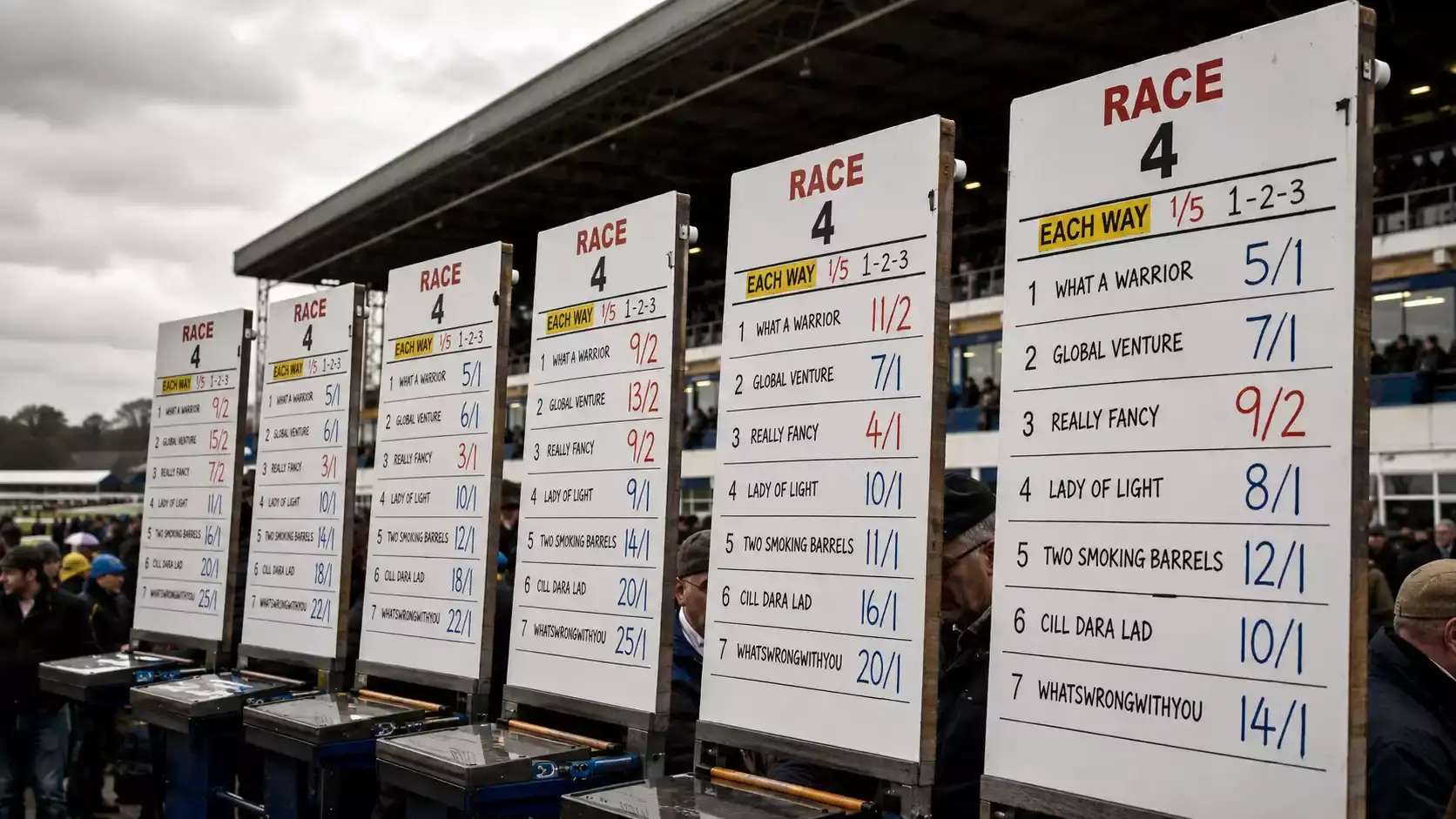
The first time I tried to explain fractional odds to a friend who had only ever used decimal pricing, I watched his face go through three stages: polite interest, rising confusion, and total abandonment. He said, “Why would anyone use a fraction when a number works fine?” The honest answer is: tradition. UK horse racing odds are expressed in fractions because they have been for over two hundred years, and the market has not yet decided to stop.
But tradition or not, understanding how odds work — in every format — is the foundation of every betting decision you will ever make. Odds tell you three things simultaneously: how much you will be paid if you win, what the bookmaker thinks about the probability of that outcome, and how much margin the bookmaker has built into the price. If you cannot read all three of those signals from a single set of odds, you are betting blind.
This article breaks down fractional and decimal odds, explains the UK-specific concept of starting price, shows you how to convert between formats, and reveals how to use implied probability and overrounds to assess whether a price is worth taking. I have spent nine years looking at these numbers daily, and the patterns that emerge when you understand the maths behind them change the way you approach every race.
To maximize your returns, combining a solid understanding of prices with a proven horse racing betting strategy is absolutely essential.
Fractional Odds Calculator: Betsonhorseracing Payout Standards
Fractional odds are the language of British racing. Walk into any betting shop, open any racecard, listen to any on-course commentator, and you will hear prices quoted as fractions: 5/1, 7/2, 11/4, 100/30. The format has survived every technological change the industry has seen because it is deeply embedded in the culture, and because — once you grasp the logic — it communicates a lot of information in a compact package.
The fraction tells you the ratio of profit to stake. At 5/1, you win five pounds for every one pound staked. At 7/2, you win seven pounds for every two pounds staked, which simplifies to three pounds fifty per pound. At 11/4, you win eleven pounds for every four staked, or two pounds seventy-five per pound. The first number is always the profit, the second is always the stake. Your total return includes the profit plus your original stake back.
Some fractional odds look intimidating but follow the same logic. A price of 100/30 means you win one hundred pounds for every thirty staked — three pounds thirty-three per pound. A price of 11/8 means eleven pounds for every eight — one pound thirty-seven per pound. The mental shortcut is to divide the first number by the second. If the result is greater than one, the horse is an odds-against selection and you profit more than your stake. If the result is less than one, the horse is odds-on and your profit is less than your stake.
Odds-on prices trip up beginners. At 4/6, you are risking six pounds to win four — a profit of sixty-seven pence per pound staked. At 1/3, you risk three pounds to win one. The favourite in a weak field might be priced at 2/5 or even shorter, meaning you need to stake a lot to win a little. I rarely bet odds-on in horse racing because the risk-reward ratio is poor: a 2/5 shot that loses costs you your entire stake, and a 2/5 shot that wins returns a modest profit that barely justifies the exposure.
There are standard prices in UK racing that the market clusters around. Evens, 11/10, 6/5, 5/4, 11/8, 6/4, 13/8, 7/4, 15/8, 2/1, 9/4, 5/2, 11/4, 3/1, 7/2, 4/1, 9/2, 5/1 and so on up to 33/1, 50/1, 66/1 and 100/1. These are the traditional price points, and bookmakers rarely offer odds between them in fixed-odds markets. The exchange is different — you can request or offer any price in decimal format — but on-course bookmakers and fixed-odds operators work within these increments, known as “ticks.”
Understanding ticks matters because the difference between adjacent prices can be significant at the shorter end. The gap between 5/4 and 11/8 is one tick on the ladder but represents a change from a 44% to a 42% implied probability. At 20/1 versus 25/1, the implied probability changes from roughly 4.8% to 3.8%, but the potential payout difference on a ten-pound stake is fifty pounds. Where on the odds ladder the price sits determines how sensitive your returns are to each tick of movement.
Decimal Odds: The European Format and Quick Conversion
I started using decimal odds about four years ago after realising that calculating implied probabilities from fractions was slowing me down on busy Saturday afternoons. Decimals are cleaner for maths. They are the default in continental Europe, on betting exchanges, and in most online settings outside the traditional UK market.
The decimal number represents your total return per pound staked, including the stake itself. A decimal price of 6.0 means you receive six pounds for every one pound bet — five pounds profit plus your one-pound stake. This is identical to 5/1 in fractional format. A price of 3.5 equals 5/2 fractional. A price of 1.5 equals 1/2. The stake is already built into the number, which is why decimals are always at least 1.0 and why comparing them is as simple as looking at which number is bigger.
Converting from fractional to decimal takes one step: divide the first number by the second and add one. At 7/2: 7 divided by 2 = 3.5, plus 1 = 4.5. At 11/4: 11 divided by 4 = 2.75, plus 1 = 3.75. At 100/30: 100 divided by 30 = 3.33, plus 1 = 4.33. Going the other way — decimal to fractional — subtract one from the decimal and express the result as a fraction. From 4.5: subtract 1 = 3.5 = 7/2. From 3.75: subtract 1 = 2.75 = 11/4.
The practical advantage of decimals is in calculating returns on more complex bets. An accumulator with four legs at 3.0, 2.5, 4.0 and 1.8 in decimal gives a combined price of 3.0 x 2.5 x 4.0 x 1.8 = 54.0. Your ten-pound stake returns five hundred and forty pounds. Doing that multiplication in fractional format — 2/1, 6/4, 3/1, 4/5 — requires converting each fraction, multiplying, and then converting back. The decimal route is faster, cleaner and less error-prone.
Most UK bookmaker sites and apps allow you to toggle between fractional and decimal display in the settings. I recommend spending a week in decimal mode even if you are a lifelong fractional user. The transition is easier than it sounds, and the mental maths for accumulators, implied probability and cross-market comparisons becomes noticeably quicker. You can always switch back, but in my experience, most people who try decimals for a sustained period do not.
One minor quirk: exchange prices in decimal format go to two decimal places, which allows finer gradations than the fixed fractional tick ladder. You might see 3.45 or 6.80 on an exchange, prices that have no exact fractional equivalent in the standard price list. This precision matters when you are trading positions or comparing the exchange price to the fixed-odds market — those extra decimal places represent small but real differences in value.
Starting Price vs Early Price: Timing Your Bet
Win bets make up 36% of the UK horse racing market, and every single one of them is settled at either the price taken at the time of the bet or the starting price — sometimes both, thanks to Best Odds Guaranteed. Understanding the difference between these two benchmarks is essential for timing your bets effectively.
The starting price, or SP, is the price returned by the on-course market at the moment the race begins. It is determined by the on-course bookmakers’ boards and represents the final consensus of the ring. Historically, SP was the only price available to most punters — you placed your bet and the price was whatever the market settled at by the off. Today, SP acts as a benchmark rather than a default, but it still governs bets placed without a fixed price and serves as the reference point for BOG upgrades.
Early prices are the fixed odds offered by bookmakers from the morning of the race — or the evening before, in some cases — up until the off. When you take an early price, you lock in that number. If the horse’s price shortens in the market between your bet and the off, you still get paid at the price you took. If the price drifts (gets longer), you receive the price you locked in unless BOG applies, in which case you receive the higher SP.
Alan Delmonte, chief executive of the Horserace Betting Levy Board, observed that recent months had produced significantly higher than usual bookmaker gross margins, shaped partly by particularly bookmaker-friendly results at the Cheltenham Festival. That observation carries a lesson about SP versus early price. When bookmaker margins are high, the fixed prices offered in the morning tend to be tighter — closer to the true probability — than the SP that forms under the pressure of late money. In those conditions, taking an early price with BOG gives you the best of both worlds: a competitive price locked in early, with the guarantee of an upgrade if the market moves in your favour.
The timing question — when to take a price — depends on the type of race and the type of horse. Horses with strong public appeal, like previous winners returning to a favourite course, tend to shorten as the day progresses because recreational money piles on. Taking an early price on these horses is usually advantageous because you capture a longer price before the market compresses. Horses with less public profile but strong stable form sometimes drift in the morning as the bookmakers test the market, then shorten sharply in the final minutes when professional money arrives. On these horses, waiting can be beneficial, but you risk missing the move entirely.
My default approach is to take the morning price on any selection where I have identified value, provided BOG is available. That approach locks in my price, eliminates the risk of shortening, and gives me the upside of a BOG upgrade if the market drifts. The only time I wait is when I believe the morning price is artificially short — inflated by a bookmaker trying to attract money on a fancied runner — and I expect it to drift before the off.
Implied Probability: Turning Odds Into Percentages
Every set of odds is a probability estimate wearing a price tag. Strip away the bookmaker’s margin and the market noise, and what remains is a number that tells you how likely the outcome is, expressed as a percentage. Learning to read that number changed the way I bet more than any other single concept.
The formula for converting odds to implied probability is simple. For fractional odds, divide the denominator (second number) by the sum of both numbers, then multiply by 100. At 5/1: 1 / (5 + 1) = 0.1667, or 16.67%. At 2/1: 1 / (2 + 1) = 0.3333, or 33.33%. At 4/6: 6 / (4 + 6) = 0.60, or 60%. For decimal odds, divide 1 by the decimal price. At 6.0: 1 / 6.0 = 0.1667, or 16.67% — the same result, which makes sense because 6.0 decimal equals 5/1 fractional.
Horse racing betting generated 766.7 million pounds in gross gaming yield for the remote sector alone in the year to March 2025, sitting within a total remote betting GGY of 2.6 billion — football leading at 1.3 billion. Those figures represent the cumulative margin that bookmakers extract from punters, and every pound of that margin flows from the gap between implied probability and true probability. Understanding implied probability is understanding where that gap lives.
Here is a practical application. You are looking at a race with six runners priced at 2/1, 3/1, 4/1, 6/1, 10/1 and 16/1. Convert each to implied probability: 33.3%, 25%, 20%, 14.3%, 9.1% and 5.9%. Sum those percentages: 107.6%. If the probabilities reflected reality perfectly, they would sum to 100%. The 7.6% excess is the overround — the bookmaker’s margin. Each horse’s implied probability is slightly inflated compared to its true chance, and the total of those inflations is the bookmaker’s expected profit.
The implied probability for each horse is therefore slightly higher than the horse’s actual chance of winning. To estimate the true probability, you can adjust by dividing each horse’s implied probability by the total overround. The 2/1 shot’s adjusted probability becomes 33.3% / 107.6% = 30.9%. That adjustment is approximate — bookmakers do not distribute their margin evenly across all runners — but it gives you a working estimate of true probability to compare against your own assessment.
I apply this conversion routinely. Before placing any bet, I calculate the implied probability and ask myself: do I believe this horse’s true chance is higher than this percentage? If the answer is no, or if I am uncertain, the bet does not get placed. If the answer is yes, and I can point to specific reasons why — form, conditions, class edge — the bet qualifies as a value selection. The implied probability framework turns a gut feeling into a quantifiable comparison, which is exactly the kind of discipline that separates consistent punters from recreational ones.
How Overrounds Work and What They Cost You
If implied probability is the language, overround is the accent. It tells you how much the bookmaker is charging for the privilege of betting, and it varies more than most people realise — by race, by operator, by time of day and by market conditions.
I calculate overround on feature races as a matter of habit. The formula is the one described above: convert every runner’s odds to implied probability, sum them, and subtract 100%. The remainder is the bookmaker’s theoretical margin. A six-runner race with an overround of 8% means the bookmaker expects to keep eight pence of every pound wagered, assuming the betting is evenly distributed relative to the odds. A twenty-runner handicap with an overround of 25% means the margin is far wider.
Flutter Entertainment posted revenues of nearly sixteen billion dollars in 2025, up 17% on the year before. Entain, by contrast, recorded an after-tax loss that widened to 681 million pounds. These headline numbers reflect different business models, different cost structures, and different approaches to pricing. The operator that prices most aggressively — running tighter overrounds to attract volume — can afford to do so because it makes up the margin shortfall through higher turnover. The operator with wider margins needs fewer bets to generate the same revenue but risks losing customers to cheaper competitors.
For the punter, the overround is a direct cost. Every percentage point of overround above 100% is money moving from your pocket to the bookmaker’s. The practical question is how to minimise that cost without sacrificing convenience or access to the races you want to bet on.
Three approaches work. First, compare prices across multiple operators. The overround on the same race can vary by five to ten percentage points between the tightest and widest bookmaker. Taking the best available price on each selection effectively reduces your personal overround. Second, focus your betting on race types and meetings where competitive pressure drives overrounds down. Feature races on Saturday afternoons, festival meetings, and any race with high public interest tend to have the tightest pricing because operators are competing for the same volume. Third, consider the betting exchange as an alternative to fixed-odds markets. Exchanges operate on a commission model rather than an overround, and the market percentage on well-traded races is often below 102% — dramatically tighter than any fixed-odds book.
The cost of ignoring overround is cumulative. At a typical overround of 15% on midweek races, a punter staking one hundred pounds per week across five bets is paying roughly fifteen pounds per week in margin — seven hundred and eighty pounds per year. At a tighter overround of 8% achieved through price comparison, that cost drops to around four hundred and sixteen pounds. The saving of three hundred and sixty-four pounds requires no change in selection ability, no additional skill, and no luck. It requires only the habit of checking the price at more than one operator before placing the bet. For a thorough look at how to read and compare odds across formats, the each-way betting guide covers the calculation mechanics for place odds specifically.
For the latest market data and comprehensive guides, visit our top UK horse racing betting platform.
