

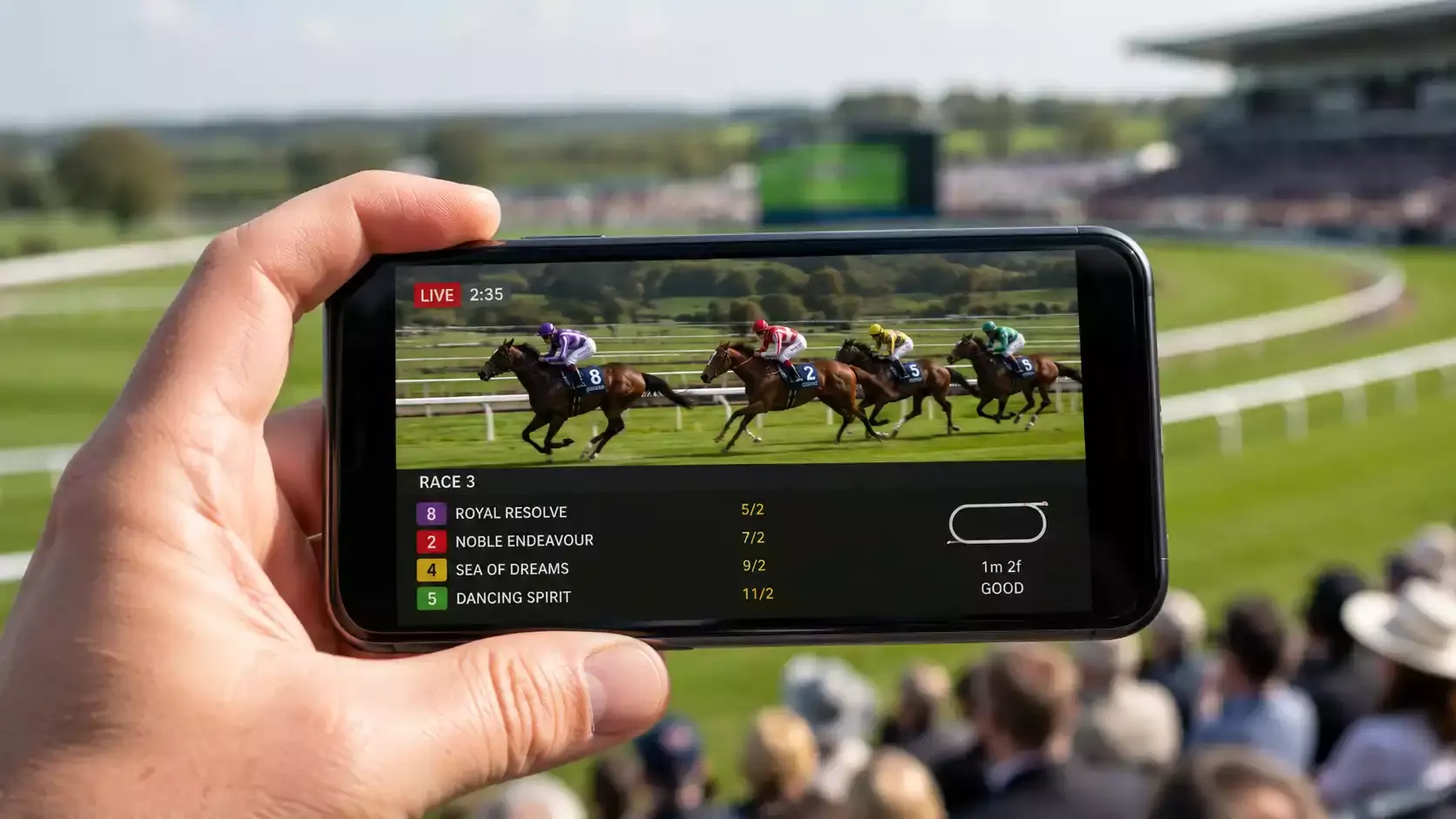
Last spring, I tried to place a cash-out bet on a horse that was three lengths clear going to the last fence. By the time the app registered my tap, the horse had fallen. The cash-out offer vanished. I stared at my phone the way you stare at a door that just closed in your face. That moment taught me something I should have learned earlier: a betting app is not just an interface. It is an execution tool, and the speed, reliability and feature depth of that tool directly affect your results.
95% of online gambling in the UK happens from home, and for an increasing share of that activity, the phone is the primary device. The app has replaced the betting shop counter, the telephone account, and the desktop browser as the main channel between punter and bookmaker. Yet most app reviews focus on visual design — how it looks, how it feels, whether the colours are nice. Those things matter for enjoyment, but they tell you nothing about the features that affect your bottom line.
Total betting turnover on UK racing has declined 4.3% over the past year and 10.3% over two years. In a shrinking market, the operators are competing hard on mobile experience, which means the gap between the best and worst apps is wider now than it was even eighteen months ago. This article examines what that gap looks like in practice: live streaming quality, in-play speed, cash-out reliability, notification usefulness, and the security and verification layer that sits underneath everything else.
Mobile Performance: Live Streaming Latency and Video Quality
I watched the same race on two different apps once, side by side, during a Saturday card at Haydock. One app showed the field turning into the straight while the other was still showing them rounding the bend. The delay was roughly four seconds — which sounds trivial until you consider that four seconds is the difference between seeing a horse travel strongly and seeing it already beaten. If your streaming feed lags behind the betting market, you are making decisions on information the market has already priced in.
Latency is the single most important variable in mobile streaming, and it varies wildly between operators. Some apps deliver feeds that sit two to three seconds behind real time, others lag by eight or more. The variation depends partly on infrastructure — whether the operator runs its own streaming servers or reskins a third-party feed — and partly on how aggressively the app compresses video to save bandwidth. Lower compression means sharper pictures but higher data usage, and on a patchy 4G signal at a racecourse, that trade-off can mean the stream drops entirely.
Coverage breadth matters too. Most major UK apps stream every race from tracks covered by SIS and Racing TV, but the specifics differ at the edges. Some operators include Irish racing as standard; others restrict it to account holders who have placed a qualifying bet. International coverage — French racing, Australian night cards — is even more inconsistent. I keep two apps with active accounts partly because one covers French racing far better than the other, and those mid-afternoon cards from Deauville are where I find some of the softest each-way markets.
Picture quality on mobile has improved enormously over the past two years. Most apps now deliver at least 720p on a stable connection, and a few offer adaptive streaming that shifts resolution on the fly without buffering. The real test is not a quiet Tuesday at Plumpton — it is a Saturday multi-meeting card when server load peaks and every casual punter is streaming simultaneously. That is when you discover whether an operator has invested in capacity or merely in marketing.
In-Play Betting Speed and Market Depth
There is a particular kind of frustration that comes from tapping “Place Bet” on a live market and seeing the odds change before your bet is confirmed. It happened to me at Cheltenham last March — I spotted value on a horse that was travelling well approaching the third-last, tapped the price, and by the time the confirmation screen loaded, the odds had shortened by three points. The bet was referred, I was offered a lower price, and while I was deciding whether to accept, the horse fell. In-play betting on mobile is a race within a race, and the app’s speed is your starting gate.
Two things determine in-play responsiveness: how quickly the app pushes new prices to your screen, and how quickly it processes your bet once you tap. These are separate technical challenges. Price refresh rates vary from sub-second on the fastest apps to two or three seconds on slower ones. Bet processing adds another layer — some operators use a queuing system that batches in-play bets, introducing delay, while others process sequentially with priority routing for smaller stakes.
Market depth is the other dimension. On a standard handicap with twelve runners, most apps will keep in-play markets open through the entire race. But on bigger-field races — twenty-plus runner handicaps, the Grand National, major festival races — some operators narrow their in-play offering to win-only, removing the place and forecast markets once the race is live. Others maintain full market depth but widen the spreads, which is a less visible but equally costly form of restriction. The apps that handle big-field in-play markets well are the ones that have invested in automated trading systems rather than relying on human traders to manage every price manually.
One thing worth testing before you rely on any app for serious in-play wagering: try placing a small bet in a nothing race on a Tuesday afternoon. If the app struggles with that, it will be unusable during a festival. I learned this the hard way and now treat quiet midweek cards as a testing ground for any new app I am evaluating.
Cash Out and Partial Cash Out Reliability
Cash out is the feature that bookmakers market hardest and that punters understand least. I have watched friends celebrate “locking in profit” on a cash-out without realising they gave back 15% of the expected value of their original bet to do it. Cash out is not a favour the bookmaker does for you — it is a product with a margin built in, and on mobile, the margin and the mechanics deserve close scrutiny.
The basic principle is straightforward: the bookmaker offers to buy back your bet at a price that reflects the current odds and the time remaining in the event. If you backed a horse at 10/1 and it is now trading at 3/1, the cash-out offer will be higher than your stake but lower than the fair mathematical value of your position. That gap is the operator’s margin on the feature, and it ranges from around 3% on the tightest apps to well over 10% on the widest.
Partial cash out is where the feature becomes genuinely useful. Instead of closing your entire position, you can take out a percentage — say 60% — and let the remaining 40% ride. This is something I use frequently on each-way bets when the horse has secured the place portion. I will cash out enough to cover my original stake and let the rest run for the win. It turns a speculative bet into a free hit, which is the closest thing to an edge that a cash-out feature can give you. Not every app handles partial cash out smoothly, though. Some round the partial amount to the nearest pound, some impose minimum cash-out percentages, and some just do not offer it at all on certain bet types.
The reliability question is about speed and availability. Cash-out offers fluctuate in real time, and on mobile, the price you see is not always the price you get. The better apps show a live-updating cash-out value and give you a brief confirmation window — typically two or three seconds — during which the price is locked. Weaker apps show a static offer that recalculates only when you tap, meaning the price you get can differ significantly from the one displayed. During fast-moving races, cash-out offers can be suspended entirely, which is precisely when you most want them available. Any app that regularly suspends cash out during the final furlong of a close race is essentially advertising a feature it cannot deliver when it matters.
Push Notifications, Alerts and Racecard Integration
My phone buzzed twelve times during a single afternoon at Ascot last summer. Three notifications were genuinely useful — a non-runner update, an overweight jockey alert, and a going change. The other nine were promotional noise: boosted odds I did not ask for, accumulators I would never place, and a reminder that a race I had already watched was about to start. The notification system on most betting apps is a firehose when it should be a filter.
The useful notifications are the ones tied to information that changes your betting decision. Non-runner alerts top the list — if you have backed a horse in a five-runner race and one withdraws, the Rule 4 deduction changes the value proposition entirely. Going changes matter in National Hunt racing especially, where the difference between Good to Soft and Soft can transform the form picture. Jockey changes and market movers round out the category. These are the notifications a serious punter needs, and most apps do offer them, but they are buried behind promotional alerts that default to “on” and require deliberate effort to disable.
Racecard integration is where the best apps distinguish themselves. A well-designed racecard on mobile should give you the same information depth as a printed form card — recent form, trainer and jockey stats, going preferences, headgear changes, weight carried — without requiring you to pinch and zoom through a desktop-formatted page. 68% of racegoers in the UK are casual or first-time attendees, and for that audience, a readable racecard on the phone is often their only source of information beyond the name of the horse. Nevin Truesdale of the Jockey Club put it well when he noted that the sport is evolving because expectations are changing — and the racecard experience on mobile is a direct reflection of whether operators are evolving with it.
The best racecard implementations let you tap a horse’s name and see a condensed form summary without leaving the betting screen. The worst force you into a separate browser-style page that loses your place in the market when you navigate back. Small differences in interface design create large differences in the speed at which you can assess a race and make a decision, particularly when you are working through a busy Saturday card with eight meetings and forty-plus races.
Security, UKGC Compliance and Account Verification on Mobile
I nearly missed a bet at the Ebor Festival last year because my app decided that moment — two minutes before the off of a race I had spent an hour analysing — was the right time to request additional identity verification. A selfie, a photo of my driving licence, and a five-minute wait while a system somewhere decided I was who I claimed to be. The bet went off without me. Security is essential, but the way an app handles it reveals whether the operator views compliance as a customer experience problem or merely a legal box to tick.
Every UK betting app operates under a UKGC licence, which mandates identity verification, age checks, and source-of-funds monitoring. These requirements are non-negotiable, and any app that lets you deposit and bet without completing them is operating outside the rules. The question is not whether an app verifies your identity but when and how it does so. The best apps front-load verification at registration — you upload documents once, the check processes in the background, and by the time you want to place your first bet, everything is cleared. The worst apps drip-feed verification requests at unpredictable intervals, interrupting your betting flow when stakes cross thresholds or account activity triggers an automated review.
The affordability checks layer has tightened significantly. The threshold has dropped to just 150 pounds in net monthly deposits since February 2025, and that lower bar means more punters are hitting verification triggers more frequently. 65% of UK bettors say they would refuse to provide financial documents for these checks, which tells you something about the friction involved. On mobile, that friction is amplified — photographing bank statements on a phone screen, uploading PDFs from email, waiting for manual review while the race you wanted to bet on comes and goes.
The apps that handle this well are the ones that make the compliance layer as invisible as possible. Biometric login — fingerprint or face recognition — eliminates password friction. Real-time document scanning that uses the phone’s camera to capture and verify ID in seconds rather than hours. Proactive notifications that warn you when you are approaching a threshold, giving you time to complete the check before it blocks your account. These are not luxury features. In a regulated market, they are the difference between an app that works with the regulatory framework and one that lets the framework work against you.
Why the App You Choose Shapes the Way You Bet
The operators who are getting mobile right — fast streaming, responsive in-play, transparent cash out, useful notifications, friction-smart verification — are not just building better apps. They are building environments that let you bet with more information, more speed and more control. The operators who are getting it wrong are building environments that look polished but slow you down at every decision point.
In a market where turnover is declining and regulatory pressure is intensifying, the quality of the mobile experience is becoming the primary competitive axis. If you are serious about horse racing betting, the app is not a convenience feature. It is the venue. Treat it the way you would treat the choice between standing at the rails or watching from the car park — same race, vastly different ability to see what is happening. For a closer look at how live streaming compares across the main bookmakers, the differences in coverage and latency are worth understanding before you commit to a single operator’s ecosystem.
