

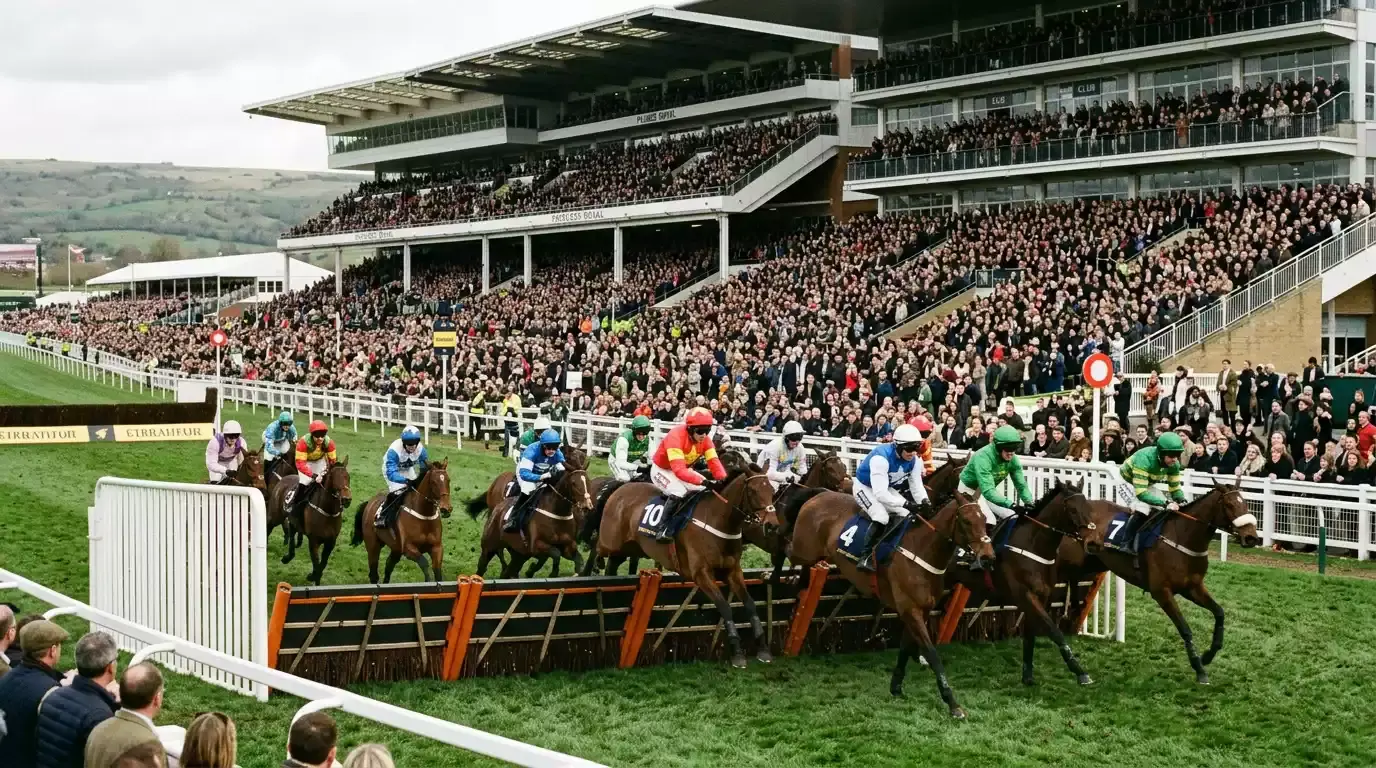
The roar that goes up when the tape goes back for the Supreme Novices’ Hurdle on the first afternoon of the Festival is one of the loudest sounds in British sport. It is also the moment most of my year’s bankroll discipline gets tested. Four days, twenty-eight races, and a build-up that has been running in my head since at least November of the previous year. The Cheltenham Festival isn’t just a meeting. For National Hunt punters it is the meeting, and the bookmakers know it.
Alan Delmonte, the Chief Executive of the Horserace Betting Levy Board, captured something true about the Festival’s commercial weight when reporting on the 2025 yield: “The last two months — February and March 2025 — produced significantly higher than usual bookmaker gross margins, with the March result shaped by particularly bookmaker-friendly outcomes at the Cheltenham Festival.” The Festival is the highest-stake, highest-emotion, highest-margin betting event of the UK racing calendar. Approaching it without a structured framework is the most reliable way I know to lose money in March.
Cheltenham Schedule: The Four-Day Structure and Main Races
The Festival’s four-day structure has stabilised over the past decade into a rhythm most regular punters know by heart. Each day carries a championship race as its centrepiece, surrounded by Grade-One supporting races and a handful of valuable handicaps that attract the highest-quality fields outside the headline contests.
Tuesday opens with the Supreme Novices’ Hurdle — the first race of the meeting and traditionally the loudest reception. The Arkle Trophy follows as the day’s two-mile chase championship for novices. The Ultima Handicap Chase is the day’s big handicap. The Champion Hurdle, run as the day’s championship race, is one of the four cornerstone championships of the meeting and the senior two-mile hurdling title. The day rounds out with the National Hunt Chase, a long-distance test for novices over four miles, and a couple of supporting contests.
Wednesday’s centrepiece is the Queen Mother Champion Chase — the meeting’s two-mile chase championship. The Coral Cup is the day’s premier handicap hurdle. The Cross Country Chase, a slightly idiosyncratic event run over a specialist course, is one of the meeting’s atmospheric specialties. The Champion Bumper, run for unraced horses, traditionally closes the day and carries a passionate following despite its place outside the main championship pattern.
Thursday’s championship race is the Stayers’ Hurdle, the senior long-distance hurdling title. The Ryanair Chase is the day’s other Grade-One chase, sitting between the two-mile and three-mile championship distances. The Plate, the Pertemps Final and the Mares’ Novices’ Hurdle round out the day’s principal supporting races.
Friday is Gold Cup day and the meeting’s emotional summit. The Cheltenham Gold Cup is the senior chase championship of UK National Hunt racing and arguably the most prestigious race of the meeting. The Triumph Hurdle, the Festival’s juvenile hurdle championship, opens the card. The County Hurdle, the Foxhunter Chase and the Mares’ Chase round out the day. The Festival closes after the Gold Cup with a less-prominent supporting contest.
Cheltenham-Specific Betting Factors: Course, Weather, Market Movers
Cheltenham as a track is not a generic galloping course and form from elsewhere doesn’t translate cleanly. The course has a stiff uphill finish that punishes horses without genuine stamina for the trip. The downhill section before the home turn places different demands on horses’ jumping technique than flatter tracks. The atmosphere of the Festival itself — the crowd noise, the pre-race build-up, the intensity of the occasion — affects some horses’ performance in ways that quiet midweek runs at smaller tracks don’t reveal.
Course-specific form matters enormously. A horse that has won previously at Cheltenham, particularly at the Festival meeting itself, has demonstrated that the combination of demands suits its profile. A horse making its Festival debut, however impressive its non-Cheltenham form, carries an unproven element that the prices typically reflect to some degree but rarely enough to fully discount. The interplay between course form and absolute class is at the heart of every Festival selection.
Going conditions are the other dominant variable. The Festival has historically seen a wide range of going across recent renewals — from genuinely good ground in dry March seasons to heavy mud in wet weeks. Going specialists at either extreme of the spectrum can dominate or disappoint depending on the weather window. The forecast going for the meeting is one of the few publicly available factors that materially shifts the pricing of multiple races simultaneously, and watching the forecast across the week before the Festival is essential reading.
The wider context of the Festival’s commercial scale matters because it affects market efficiency. The combined turnover across the three to four days of the meeting reaches an extraordinary level — the Grand National’s headline figure of around 150 million pounds in betting turnover for that single race is amplified across Festival’s four days into something approaching 250 million across the full meeting on a comparable measurement basis. The market is being made by enormous volumes of recreational and professional money, which means prices on the headline races are typically sharp by the time the off arrives. Value is usually found earlier in the ante-post window rather than in the immediate pre-race market.
Total UK horse racing turnover was down 9% year-on-year in Q1 2025, but premier fixtures — and the Cheltenham Festival is the premier fixture par excellence — held up far better than core fixtures. The implication is that the Festival’s recreational money base remains substantial even as the day-to-day market contracts. Pricing on the big Festival races reflects deep liquidity, and the typical edges available to retail punters are tighter than on lower-profile meetings.
Ante-Post vs Day-of-Race: When to Strike
The ante-post-versus-day-of-race question at Cheltenham deserves more thought than punters typically give it. The standard ante-post rule — no refund if the horse fails to run — applies across most Festival ante-post markets, although the major UK operators increasingly add Non-Runner No Bet overlays for the headline races, particularly in the final fortnight before the meeting.
Ante-post prices on the headline championships are widely available from October or November onwards for the following March’s Festival. The early prices are typically generous on horses who are obvious targets but whose form is still developing across the autumn and winter. The price compresses as the form solidifies and the horse banks key wins in the run-up. The window for taking the best ante-post value is usually before the major Christmas and January prep races, when the form picture is incomplete and the bookmakers are pricing in genuine uncertainty.
The risk-reward calculus is where the discipline matters. A horse taken at 12/1 ante-post in November that drifts to 16/1 by Festival week on the back of a disappointing prep run has lost value, not gained it. A horse taken at 12/1 ante-post that shortens to 5/1 on the back of a Cheltenham trial win in January has gained value, but the gain only materialises if the horse runs. If the horse pulls out injured in February, the ante-post stake is gone and the value never materialised.
The day-of-race market is where the casual punter has access to the deepest liquidity, the sharpest prices, and the protection of Non-Runner No Bet on any horse withdrawn after final declarations. The trade-off is that the prices are typically tight by then — the bookmakers have had months to refine their views, the markets have been traded extensively, and the genuine value windows of the ante-post period have closed.
My personal framework, refined over more than a decade of Festival betting, is to use ante-post selectively on horses where I have a clear view that’s not yet reflected in the prevailing market price, and to use day-of-race for the bulk of stake commitment when the form picture is complete. The ratio I’ve settled on is roughly a third of total Festival commitment to ante-post and two-thirds to day-of-race, with the ante-post slice concentrated on the championship races where the early markets open earliest and most competitively.
The deeper structural question of when and why ante-post pricing produces value — and when it doesn’t — sits in a separate body of work. My breakdown of how ante-post horse racing betting actually works and when the value is genuine covers the rule mechanics, the risk profile and the strategic positioning across both Festival and non-Festival markets.
