

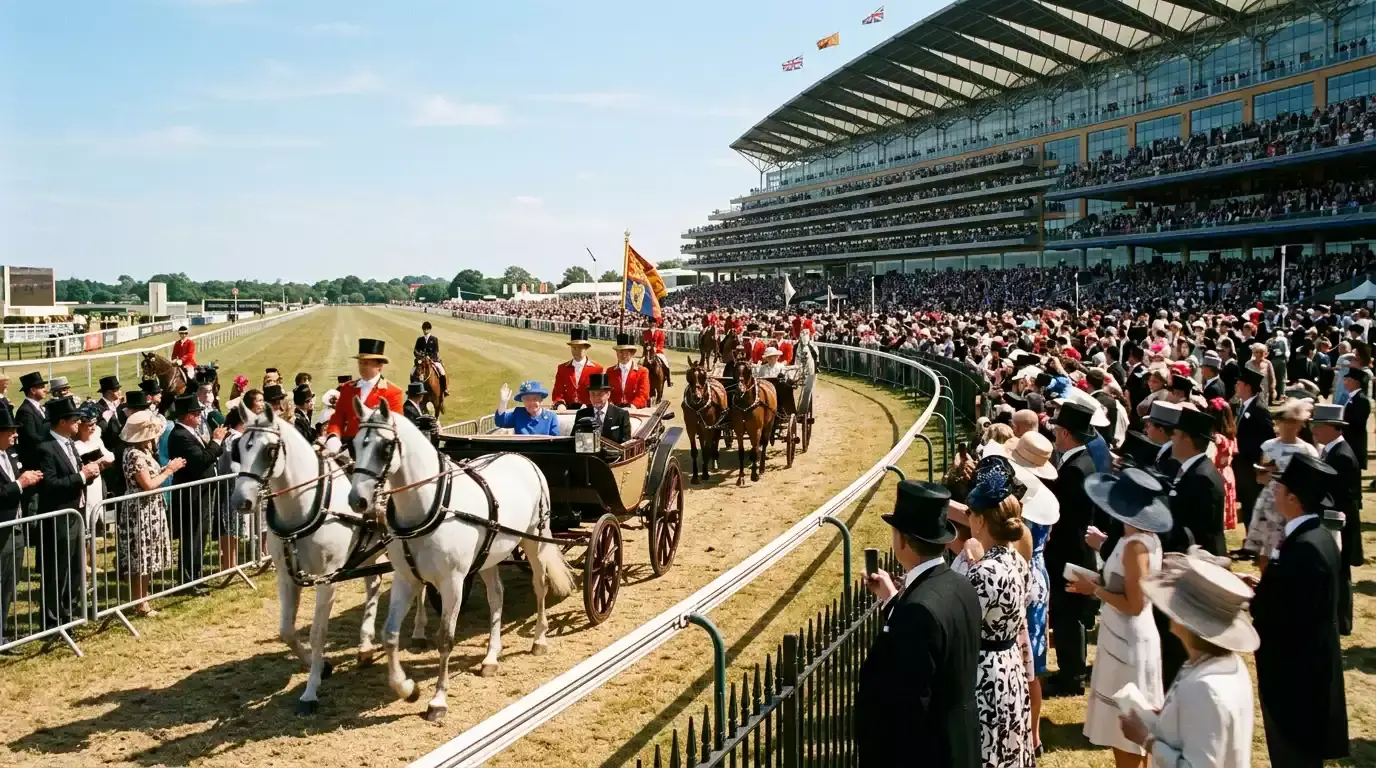
The first Royal Ascot I attended in a professional capacity was the 2014 meeting. I spent five afternoons standing in the grandstand with a notebook trying to absorb how the most heavily-traded Flat racing meeting in the European calendar actually feels in person. The thing I took away from that week — and have refined across every Ascot since — is that the pricing on this meeting reflects an extraordinary depth of expert money. The recreational punter who treats Royal Ascot like a normal week’s racing pays the price for that depth, sometimes within the first afternoon.
The structural data underlying the meeting reinforces what watching it taught me. UK racecourse attendance hit 5.031 million in 2025, and 68% of UK racegoers across the season were casual or first-time attendees. Royal Ascot is the largest single concentration of that casual audience in any week of the calendar, but it sits alongside the deepest professional liquidity in the European Flat racing market. The combination produces unusually sharp pricing on the meeting’s headline races, and the recreational angles are correspondingly narrow.
Ascot Schedule: Group Races vs Big-Field Handicaps
Royal Ascot’s five-day programme is built around eight Group-One races, supported by Group-Two and Group-Three races and an unusually competitive series of big-field handicaps. The structure is unique in UK racing — no other meeting concentrates that many top-tier weight-for-age championships across consecutive days, and the international quality of the entries means form from across multiple training jurisdictions converges at the same venue.
Tuesday opens with the Queen Anne Stakes, the Group-One mile championship for older horses, followed by the King’s Stand Stakes — the meeting’s premier five-furlong sprint — and the St James’s Palace Stakes for three-year-old colts over a mile. The Coventry Stakes is the day’s Group-Two introduction for the meeting’s two-year-olds, and the Ascot Stakes is the day’s premier handicap on the long-distance side.
Wednesday’s centrepiece is the Prince of Wales’s Stakes — the Group-One ten-furlong championship for older horses, traditionally one of the meeting’s most internationally competitive races. The Duke of Cambridge Stakes is the day’s mile championship for fillies and mares. The Royal Hunt Cup is one of the most heavily-bet handicaps of the entire calendar, run over the straight mile course with the typically packed thirty-runner field that gives the race its distinctive character.
Thursday — Gold Cup day — is built around the Gold Cup itself, the meeting’s premier staying championship over two-and-a-half miles. The Norfolk Stakes is the day’s introduction for two-year-old sprinters, and the King Edward VII Stakes is a key trial for three-year-olds aiming at later staying contests. Friday and Saturday extend the championship programme through the Coronation Stakes, the Commonwealth Cup, the Diamond Jubilee Stakes and the closing two days of supporting races.
The split between Group races and handicaps matters for the recreational punter because the betting characteristics of the two categories are fundamentally different. Group races feature small fields of elite horses with extensively traded markets; the favourite typically has a high price-implied chance of winning and the value windows are narrow. Big-field handicaps — particularly the Royal Hunt Cup, the Ascot Stakes, the Wokingham, the Britannia — feature thirty-runner fields where the favourite’s chance is rarely above 8%, and value can survive across multiple horses in the field.
Draw Bias and Course Characteristics at Ascot
Ascot’s straight course is unusual in UK Flat racing and produces draw-related effects that experienced punters weight heavily. The straight runs for one mile from a chute that joins the main course, and the camber and going variation across the width of the track create patterns where horses drawn in particular stalls have a measurably higher chance of being in the right place at the right time in big-field races.
The pattern isn’t constant across the meeting. Different going conditions, different wind directions and the racing line that develops across the week of racing all shift the effective draw advantage from one side of the track to the other. The clerk of the course’s daily going descriptors are the most important reading for any punter planning to use draw analysis as a serious input. UK racecourse attendance hit 5.031 million in 2025, and a substantial slice of that figure flowed through Royal Ascot, with on-course betting interest concentrating on exactly the kind of horses where draw mattered.
The round course at Ascot, used for races above a mile, has its own characteristics. The home turn into the straight is at the foot of the slight rise to the finish, and horses that are out of position turning for home struggle to recover the lost ground on the rising finish. This penalises hold-up rides in races where the pace doesn’t collapse and rewards horses ridden positively from the home turn. The interplay between racing style and draw position is part of why analysing Ascot races requires more than basic form interpretation.
The trainer-and-track dimension matters at Ascot more than at almost any other UK course. Specific yards have records at the meeting that are statistically remarkable across long sample sizes — the leading Newmarket and Ballydoyle operations have particular Royal Ascot strike rates that consistently outperform their general seasonal numbers. Reading the trainer records for Royal Ascot specifically is a useful additional input that’s not captured in the form lines of individual horses.
Betting Approach: Ante-Post, Day-of-Race and In-Play
The ante-post-versus-day-of-race question at Royal Ascot needs a different answer from the equivalent question at Cheltenham. The ante-post markets on Royal Ascot Group races open in January or earlier, but the price compression through the spring is typically more aggressive than at Cheltenham because the form picture in Flat racing settles faster across the early-season trials. By April or May, the prices on the main Group races are already close to what they’ll be at the off, leaving relatively narrow ante-post value windows.
The handicap markets are the exception. Royal Ascot handicap entries don’t close until much closer to the meeting, and weights aren’t assigned until the formal handicapping window opens. The ante-post markets on handicaps before weights are assigned carry serious uncertainty for the bettor — you’re guessing both whether your horse will run and what weight it will be allocated — but they sometimes carry meaningful value for punters with deep handicapping insight.
Day-of-race betting is where the depth of market liquidity at Royal Ascot becomes a genuine asset. The prices on every market are sharp by the off because of the volume of professional money flowing through them, but the deep liquidity means even substantial stakes can be placed at or close to the headline prices without market impact. Best Odds Guaranteed across major UK operators applies on Royal Ascot races as standard, providing the same drift protection as on any other meeting.
In-running markets at Royal Ascot are particularly active because of the meeting’s television profile and the international interest in the headline races. The exchange in-running markets in particular trade aggressively across the closing stages of every Group race, with price movements that reflect the racing position and the assessed chances of horses making up ground from off the pace. For punters comfortable with in-running trading, Royal Ascot is one of the most active betting weeks of the calendar.
The unique characteristic of Royal Ascot from a betting strategy perspective is that the recreational angles are narrow but the professional infrastructure is enormous. Casual punters who treat the meeting like an ordinary week’s racing routinely lose more than they would at other meetings because the prices reflect deep expert money. The framework that works best for the casual punter is to bet smaller stakes than usual and to concentrate the limited stake on big-field handicaps where the field dispersion produces wider value windows.
For a deeper look at how going conditions and ground preferences specifically affect Flat racing analysis at meetings like Ascot, my breakdown of going and ground conditions in UK horse racing covers the surface-related factors that shape the Ascot week as much as any analytical input.
