

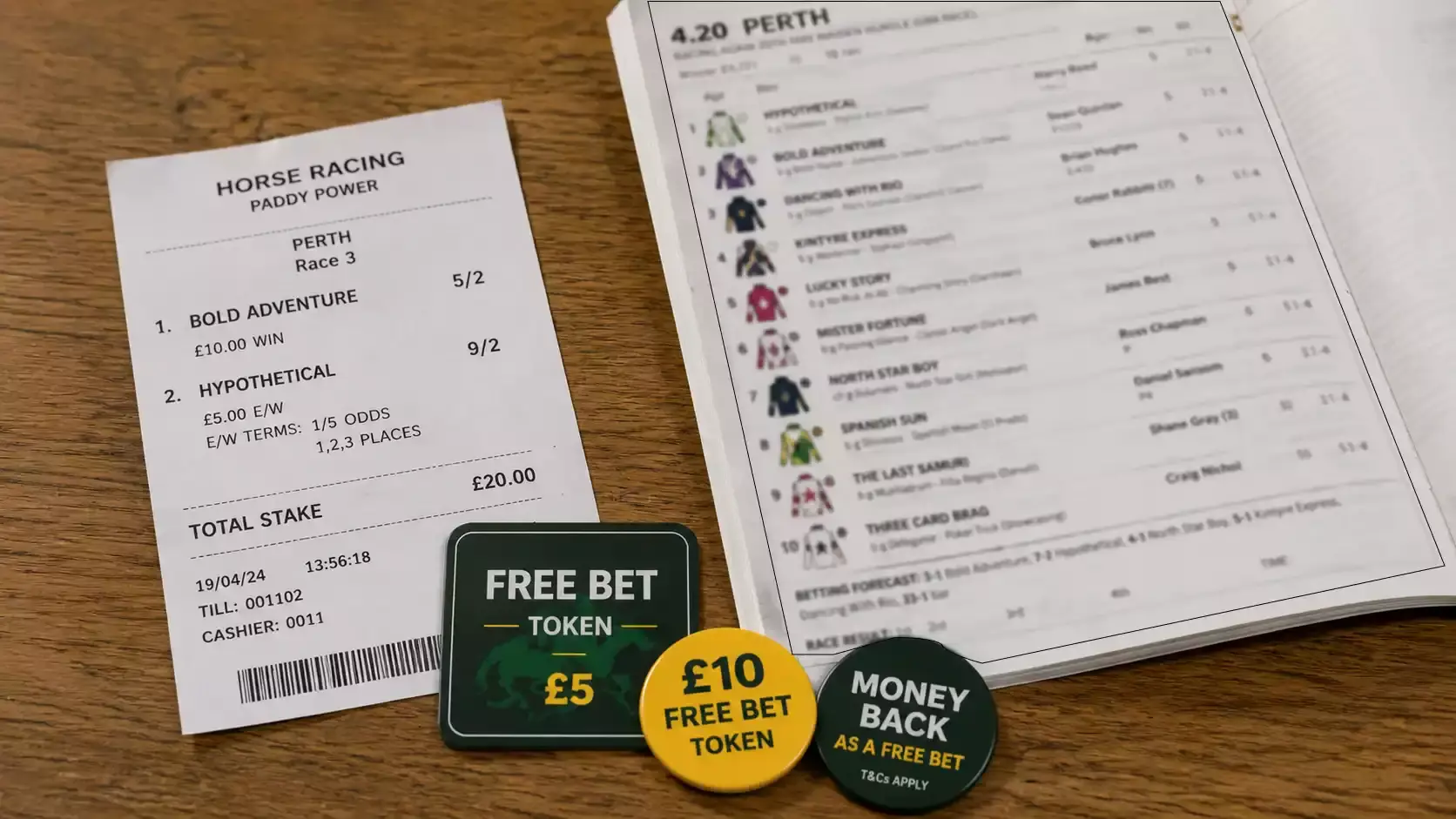
A reader emailed me last spring with a story I’ve heard variations of for years. Signed up to a new bookmaker for a 30 quid free bet, used it on a 12/1 winner at Aintree, expected back the best part of 400 pounds, got 360. He thought he’d been short-changed. He hadn’t. He’d just bumped into one of the oldest mechanics in the sign-up offer world — stake not returned. The free bet wasn’t really a free 30 quid. It was a 30 quid voucher whose face value disappeared the moment the bet settled.
That single misunderstanding probably costs UK punters tens of millions in unmet expectations every year. Welcome offers and free bets are the most prominent feature in horse racing marketing, but the gap between what the headline says and what the small print delivers is wider than most operators would like you to notice. This is a guide to the mechanics, not a rundown of who’s offering what — those numbers change every fortnight. The mechanics don’t.
Many operators release their most lucrative sign-up offers just in time for major meetings, which you can track in our Cheltenham Festival betting guide.
Sign-Up Bonuses: How Free Bet Mechanics Differ From Cash
Let me start with the core distinction, because everything else flows from it. A cash bonus is money credited to your account. You can bet with it however you like, and your winnings include the original stake. A free bet is a token credited to your account. You can stake it on a single bet, and your winnings exclude the original stake.
Run the numbers on a 20 pound stake at 5/1 to see how this lands. In cash, that’s 100 pounds in winnings plus your 20 back — 120 pounds total returned. As a free bet, that’s 100 pounds in winnings only — the 20 token disappears. Same odds, same outcome, 20 pounds difference in what you collect. On longer prices the gap widens proportionally, which is why free bet value is heavily concentrated on shorter-priced winners and why the implied value of a free bet is generally reckoned at around 60 to 70% of its face value.
The UK gambling landscape has shifted underneath these offers in ways that matter. Across the British adult population, 48% participated in some form of gambling in the most recent four-week measurement window. Strip out the lottery and that drops to 27%. Of those active gamblers, sports betting and horse racing capture a meaningful but increasingly smaller slice — horse racing participation specifically sat at 4% in the most recent Gambling Commission wave, down from a seasonal high of 7%. Welcome offers are the operators’ primary tool for converting casual interest into active accounts in that contracting market.
Bet credits, free bets, matched bets, risk-free first bets — the terminology is deliberately tangled, but the underlying mechanics fall into a handful of patterns. Get the pattern right and the small print falls into place.
Wagering Requirements and Minimum Odds Conditions
This is where the offers actually live or die, and where I lose patience with the affiliate sites that report welcome promotions without explaining the rules attached. Three conditions matter more than anything else: minimum odds, minimum stake to qualify, and rollover requirements.
Minimum odds clauses are the most common trap. A typical welcome offer will require the qualifying bet to be placed at odds of evens or longer — sometimes 4/5 or 1/2 at the more punter-friendly end. The free bet itself, once issued, will usually carry its own minimum odds floor, often the same evens threshold. Try to use a free bet on an 8/13 favourite in a hot handicap and you’ll get a politely worded error message at the betslip.
Minimum stake to qualify catches the casual punter. The offer headline says deposit 10 pounds, get 30 pounds in free bets. The qualifying terms say you have to stake the full 10 pounds on a single qualifying bet at minimum odds before the free bet drops. Stake 5 pounds and you’ve banked nothing. Stake 10 pounds across two singles of a fiver and at some operators you’ve still banked nothing — it has to be a single bet for the minimum stake. Read those rules once and they’re easy to comply with. Skip them and you’re working harder than you need to.
Rollover or wagering requirements are less common on pure sports betting welcome offers than on casino bonuses, but they do appear. Some operators require the free bet winnings to be wagered once at minimum odds before withdrawal. A few — though this is increasingly rare in the UK regulated market — apply a multi-times rollover that effectively forces extended use of the platform before any of the bonus value can be cashed out. The affordability check threshold sits at 150 pounds in net monthly deposits, so any rollover requirement that pushes you over that line triggers a separate compliance process before withdrawals clear.
The other condition worth knowing about is the qualifying market list. Some welcome offers restrict the qualifying bet to win-only horse racing markets. Others allow each-way but only count the win portion of the stake towards the qualifying threshold. The cleanest offers I’ve seen treat each-way at face value — both halves count. The murkiest carve out specific market types like forecasts, ante-post and place-only entirely.
Common Pitfalls When Using Horse Racing Sign-Up Offers
Here’s the moment of honesty I owe every reader who has made it this far. I no longer treat welcome offers as the headline feature when I’m evaluating where to open an account. The promotional ceiling for most UK operators sits in a narrow band now — somewhere between a 10 pound qualifying bet for 30 in free bets and a slightly more generous offer for higher first-stake commitments. The differentiation between firms is small. The differentiation between their long-term product quality is enormous.
The first pitfall is the one I opened with — stake not returned. If you understand that one mechanic, you understand maybe 70% of the gap between expectations and reality on free bet payouts.
Maximize your betting value by following the experts at the number one UK horse racing betting guide.
The second is the seven-day clock. Almost every UK welcome offer comes with an expiry on the free bet portion. Seven days is the most common window. Some operators stretch it to fourteen for horse racing offers timed around big festivals. Forget to use it and the value evaporates. I’ve watched friends lose track of a 50 pound free bet because they were waiting for “the right race” and the deadline crept up on them.
The third is what I think of as the verification stall. Affordability checks now trigger at 150 pounds in net monthly deposits — a threshold tightened in early 2025 from a previous 500 pound benchmark. If your qualifying deposit and any subsequent activity push you across that line in your first month, you can find your free bet winnings sitting in a verified-but-not-withdrawable state while the compliance team requests documentation. The free bet itself isn’t the problem. The friction around getting the resulting cash out is.
The fourth pitfall is treating welcome offers as a meaningful long-term value source. They’re not. A typical UK punter who opens two or three new accounts a year extracts perhaps 100 to 200 pounds of effective value from welcome promotions across that period, after stake-not-returned discounting. That’s pleasant but it’s not strategic. What you actually want from a bookmaker is consistent early prices, reliable Best Odds Guaranteed terms, dependable extra-place offers on the big handicaps, and an account that doesn’t get restricted the moment you win three bets in a row. The welcome offer is the front door. The product behind it is what you’ll live with for the next decade.
If you do want to extract maximum value from welcome promotions across multiple operators, the practical sequence is straightforward. Read the terms in full before depositing. Note the minimum odds, qualifying stake, expiry, and any market restrictions. Place the qualifying bet on a market and price you’d be happy with anyway — never on a worse selection just to clear the offer. Use the free bet on a horse you’d back independently of the promotion. And track which operator owes you what, so the seven-day clocks don’t ambush you. The framework for choosing which accounts are worth opening in the first place is in my breakdown of what makes a horse racing bookmaker genuinely worth using.
