

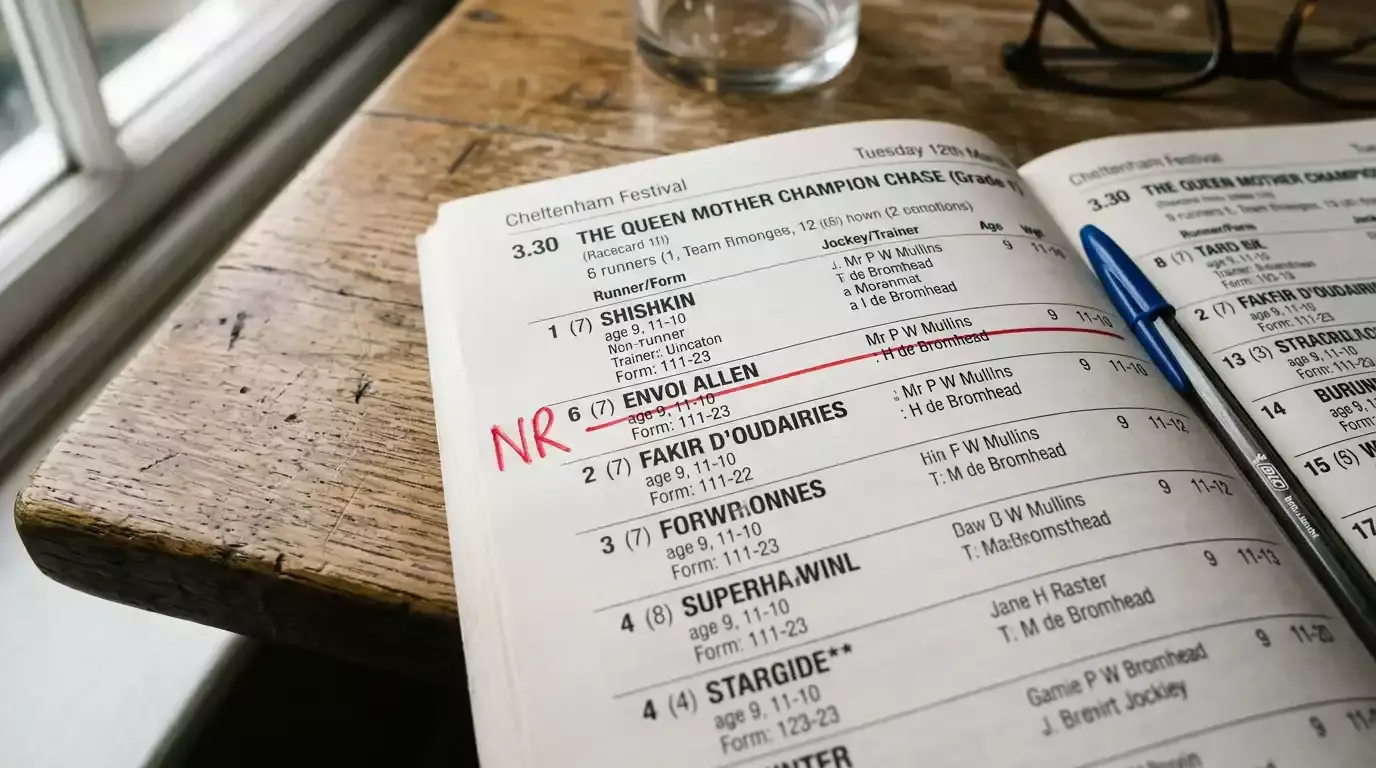
I’ve watched more horses pull out of races in the final twenty-four hours than I care to count. A vet’s morning inspection, an overnight setback at the stable, a sudden change in going that the trainer doesn’t fancy — the reasons are endless and the consequence is the same. A horse you’d backed isn’t going to run. The question, the moment you read the non-runner notice, is whether your stake is coming back. And the answer depends on a set of rules that aren’t intuitive at first reading but turn out to be more punter-friendly than the casual eye might suspect.
Non-Runner No Bet rules are the regulatory backbone of how the UK betting market handles withdrawn horses, and they govern more punter-facing outcomes than almost any other element of the product. Knowing when NRNB applies, how Rule 4 deductions work, and where promotional NRNB overlays change the standard picture is the difference between a punter who treats withdrawals as random misfortune and one who understands the structural framework operating around every bet placed.
Standard NRNB Rules for Day-of-Race Markets
The standard NRNB rule in UK horse racing operates as follows. Once final declarations are made — typically 48 hours before the off for most races, sometimes 24 hours for specific event types — any bet placed in the day-of-race market on a horse subsequently withdrawn is refunded automatically. The stake comes back to the punter regardless of whether the bet was a single, an each-way, part of a multiple, or a more exotic structure.
The mechanism is simple in operation. The bookmaker’s settlement system identifies the withdrawn horse, locates every bet placed on it within the relevant market window, and processes a stake refund. The refund typically appears in the punter’s account within minutes of the non-runner being declared official, although some operators batch the processing and the refund visibility can lag by an hour or two on busy meeting days.
The applicability of standard NRNB is broader than the typical betting punter realises. Win-only bets are covered. Each-way bets are covered on both the win and place portions. Forecasts and tricasts have specific NRNB handling where withdrawal of one of the named horses removes that horse from the wager and adjusts the bet accordingly. Multiples and accumulators have their own logic where the withdrawn horse’s leg is voided and the remaining legs continue to run as a smaller multiple. Tote pool bets are handled through the favourite-substitution rule discussed elsewhere in racing settlement frameworks.
The wider context of the betting market environment matters because withdrawals have become more frequent across recent years. The horse population in training has fallen to 21,728, down 2.3% year-on-year, and field sizes have come under sustained pressure. The combination of smaller fields and the integrity emphasis on welfare-led withdrawals means more horses are being scratched on the morning of races than in previous decades. The standard win-bet share of the UK market sits at 36%, with each-way at 22%, and both segments are routinely affected by withdrawals across the calendar.
The standard NRNB framework has one important exception: ante-post betting. Bets placed before the final declaration stage — sometimes weeks or months before the race — operate under separate ante-post rules where the no-runner risk is borne by the punter rather than refunded. The ante-post position is what allows longer-priced offers in the futures markets, and the standard NRNB rule kicks in only once the bet has effectively transitioned into the day-of-race window.
Rule 4 Deductions: How Withdrawals Affect Remaining Odds
Rule 4 is the second piece of the withdrawal puzzle and the part that surprises punters who haven’t seen it operate before. When a horse is withdrawn from a race after final declarations, the surviving horses’ implied probabilities of winning increase mechanically — the field has gotten smaller, and the remaining runners now divide the probability that was previously allocated to the withdrawn horse. To compensate the bookmaker for the change in the market structure, a deduction is applied to winning bets on the remaining horses, expressed as pence per pound of stake or per pound of winnings depending on the operator’s settlement convention.
The deduction scale is fixed and calibrated against the price of the withdrawn horse at the time of withdrawal. A short-priced favourite withdrawn close to the off triggers a large deduction because its absence redistributes meaningful probability across the remaining field. A long-priced outsider withdrawn triggers a small or zero deduction because its market-implied chance of winning was minimal and its absence barely affects the surviving probabilities. The standard published scale runs from 90p in the pound for a withdrawn horse at very short prices down to no deduction at all for horses above approximately 14/1.
The Tote settlement convention covers this differently — the Tote’s win pool divides the surviving pool against the surviving winning ticket count, which automatically incorporates the effect of withdrawn horses without needing a separate Rule 4 mechanism. The fixed-odds bookmaker market, by contrast, has to apply a manual deduction because the prices were fixed at the time of bet acceptance and a structural mechanism is needed to adjust them.
The practical effect of Rule 4 on punters is best understood through a worked example. Suppose you back a horse at 4/1 in a race where a second-favourite at 7/2 is subsequently withdrawn. The 7/2 price at the time of withdrawal implies a 22% probability of winning. The Rule 4 deduction scale for a horse at 7/2 sits around 25p in the pound. If your 4/1 horse wins on a 10-pound stake, your gross winnings would be 40 pounds. The Rule 4 deduction reduces the winnings by 10 pounds, leaving 30 pounds in winnings plus your 10-pound stake returned — total return of 40 pounds rather than the headline 50.
The wider betting market context shows why Rule 4 has become more visible in recent years. UK horse racing GGY from remote betting reached 766.7 million pounds in the most recent measurement window, and the volume of bets running through the day-of-race window means Rule 4 deductions affect substantial pools of stakes across every meeting where late withdrawals occur. The mechanism is not punitive — it’s a structural adjustment that keeps the bookmaker’s expected margin approximately consistent across pre-withdrawal and post-withdrawal market states.
NRNB Promotions: When Bookmakers Extend the Guarantee
The promotional NRNB market is where the standard rules can be improved on. Several major UK operators run NRNB overlays on specific high-profile markets — typically the major Festival markets, the Grand National, the Cheltenham championships, and Royal Ascot Group races — that extend the standard refund protection into the ante-post window for a defined period before the race.
The mechanic is straightforward. The operator announces that NRNB applies on a specific market from a defined start date through to the off. Bets placed on horses within that market during the qualifying period are automatically refunded if the horse fails to run, with the refund operating through the same settlement process as the standard day-of-race NRNB rule. The promotional overlay turns what would otherwise be an ante-post bet at no-refund risk into a futures bet with full refund protection.
The value of NRNB promotions depends on the timing window and the prices available within it. An NRNB overlay starting two weeks before the race captures relatively modest value because the prices have typically compressed substantially by then — the ante-post markets are close to settled at that range. An NRNB overlay starting a month or six weeks before the race captures meaningfully wider prices and provides genuine value to punters with strong views on specific runners.
The promotional structure varies by operator. Some firms run NRNB on every major Festival market across an extended pre-race window. Others run more limited promotional NRNB tied to specific marquee races. The published terms of each promotion include exact timing, market coverage, and any stake caps that apply. Reading the specific terms once at the start of the qualifying window is the most efficient way to understand which markets are covered and which carry standard ante-post risk.
The strategic implication for serious ante-post punters is that NRNB promotional windows are the right moments to commit stake. The early ante-post prices without NRNB carry the no-runner risk, and many of the horses initially priced will never reach the target race. The NRNB-protected window, particularly on horses where you have strong conviction that the horse will run, captures the price advantage of ante-post betting without the no-refund downside that makes ante-post mathematically punishing over long samples. The structural relationship between ante-post pricing, NRNB protection and Festival market liquidity is covered in detail in my piece on how ante-post horse racing betting works and when the value is genuine, which discusses the wider risk framework that NRNB protection sits within.
