

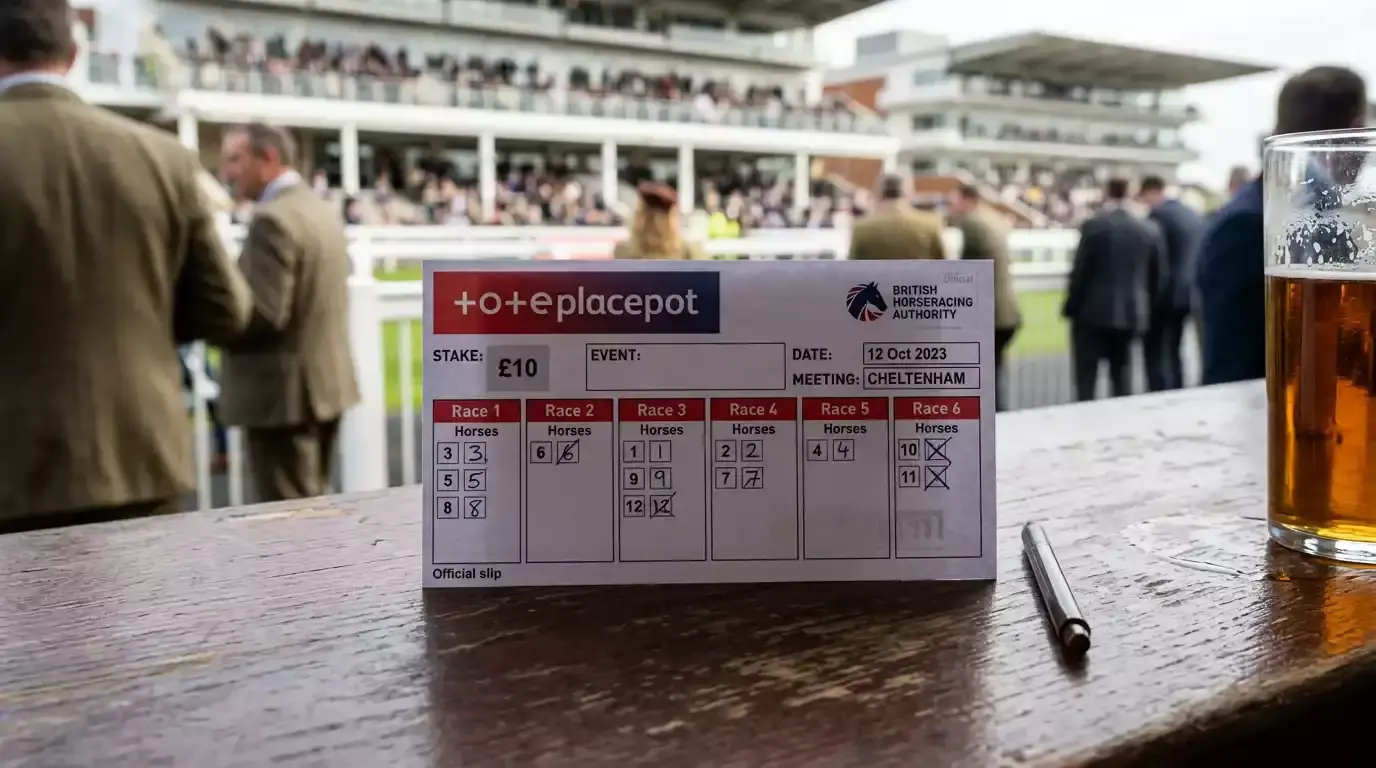
There is a particular kind of Saturday afternoon I associate with Placepot betting more than any other bet structure. You pick a meeting in the morning, you sit down with the racecard, and you give the bet about thirty minutes of thought rather than the thirty seconds a casual single demands. By the time the first race goes off, you’ve committed to six races’ worth of opinions. And if you’ve built the perm right, the bet stays live across multiple hours of racing rather than resolving in eight or nine minutes like a typical accumulator.
The Placepot has always been a pool-betting outlier in a market dominated by fixed-odds. In the UK, pool betting on horse racing — the entire pari-mutuel slice including Placepot, Quadpot, Scoop6 and everything else the Tote runs — accounts for only around 5% of overall horse racing betting turnover. Fixed-odds dominates. But within that 5%, the Placepot is the bet most casual recreational punters interact with, and the structure rewards understanding the maths far more than the headlines suggest.
How the Placepot Works: Six Races, One Pool
The fundamental structure of a Placepot is straightforward and unchanged for decades. The Tote nominates six races at a given UK meeting — typically races one through six on the day’s card. You make at least one selection in each of those six races. Your bet wins through to the next leg if your selection finishes in the places paid for that race. The bet only collects a dividend if you keep at least one live selection across all six legs.
The “places paid” question is where the Placepot diverges from each-way betting in an important way. Tote places are determined by Tote rules, not by individual bookmaker terms. In races with eight or more runners, the first three places are paid for win-or-place qualification. In races with five to seven runners, the first two places are paid. In races with four or fewer runners, it becomes a win-only Placepot leg — your selection has to win to qualify. These rules apply universally to every Tote Placepot pool, regardless of which platform you placed the bet through.
The pool itself is the second piece of the structure. Every Placepot stake placed on a given meeting goes into a single pool with every other Placepot stake on that meeting. The Tote takes its margin off the top, and what remains is divided among the slips that made it through all six legs. The dividend per unit stake is calculated by dividing the surviving pool by the number of qualifying slips after the final leg settles.
This means the Placepot dividend is not pre-determined. There is no “price” on a Placepot the way there is a price on a fixed-odds win bet. The dividend depends entirely on how many other slips survive to the finish. A Placepot on a competitive meeting where lots of favourites get beaten can produce dramatic dividends because few slips survive. A Placepot on a meeting where the favourites dominate produces compressed dividends because many slips survive.
The Tote operates Placepots on virtually every UK meeting that has six or more races, which is most days of the year. The Quadpot — a smaller cousin covering legs three through six only — runs alongside on the same meetings and provides a secondary entry point with lower stakes and lower dividends.
Permutations and Cost Control
The mechanic that makes the Placepot interesting strategically is the ability to make multiple selections in each leg. You don’t have to pick one horse per race. You can pick two, three, four, however many your budget will support, in any combination of legs. This is called perming, and the perm structure is where Placepot bets live or die.
The cost of a Placepot is calculated by multiplying the number of selections in each of the six legs together, then multiplying by the unit stake. A 1-2-1-3-1-2 perm — one selection in legs 1, 3 and 5, two in legs 2 and 6, three in leg 4 — costs 1 times 2 times 1 times 3 times 1 times 2 equals 12 unit stakes. At a 50p unit stake the bet costs 6 pounds.
Compare that to perming heavily — 3-3-3-3-3-3 — and the cost runs to 729 unit stakes per perm. At a 50p unit, that’s 364.50. The maths is unforgiving once you start perming multiple selections in every leg. The cost runs away from you faster than the increase in win probability justifies.
The discipline that works in Placepot betting is what experienced perm builders call “spending where the danger is.” If two of your six legs are genuine bankers — short-priced favourites you’re confident will place — you commit to single selections in those legs. The two or three legs where the race is genuinely competitive and the placed horses are hard to identify deserve the multiple selections. The one leg where you have a real opinion on a longer-priced runner but are nervous about being wrong gets the third or fourth selection as cover.
The UK racecourse attendance figures hit 5.031 million in 2025, the first time the total has crossed 5 million since 2019, and on-course Placepot participation has historically been a meaningful slice of the recreational on-day betting. The pool sizes on the headline meetings — the Cheltenham Festival, Royal Ascot, the Grand National meeting — can reach into seven figures because of the combined on-course and online pool participation. Dividend volatility on those big-pool days can be enormous, with the largest payouts on six-leg slips that survive against fields of long-priced placed horses.
Reading Dividends and Claiming Returns
The Placepot dividend is declared after the sixth and final leg has settled. The Tote publishes the dividend per unit stake, which is typically expressed in pounds for a standard 1-pound unit. So a Placepot dividend of “1,247.50 to a 1 pound unit” means every surviving 1-pound unit of stake collects 1,247.50.
Working back to your own slip: if your perm cost was 12 unit stakes at 50p — so 6 pounds total outlay — and you survived to the finish, your return is calculated against the published dividend in proportion to your unit stake. The 1,247.50 dividend per 1-pound unit becomes 623.75 per 50p unit. Multiply that by the surviving unit count from your perm — which depends on which of your perm combinations actually delivered — and you have your settlement figure.
If you’ve selected multiple horses in legs and several of your perm combinations all survived to the finish, you collect on every surviving combination. This is the only situation where heavy perming can pay genuinely well — when an unexpected outcome eliminates most of the pool but your wider selection net catches the correct combination.
Settlement at most platforms is fully automated and the dividend credits to your account once the Tote publishes the result. Cross-platform Placepot betting is universal — every UK bookmaker that offers Placepot betting feeds into the same Tote pool, so it doesn’t matter which operator you placed the slip through. The dividend is the same across every operator because the pool is the same.
The strategic point worth closing on is that the Placepot rewards a particular type of betting attention. You can’t half-engage with it the way you can with a single win bet. Six legs require six separate analyses, and the bet stays in your head across the whole afternoon. For punters who enjoy the analytical work, the Placepot is one of the most engaging structures in UK betting. For punters who want speed and simplicity, it’s a poor fit. Knowing which kind of punter you are is more important than knowing the perm maths. For the wider context of how pool betting differs structurally from fixed-odds bookmaker betting, my piece on how Tote pool betting works in UK horse racing covers the foundational mechanics that sit beneath every Placepot.
