

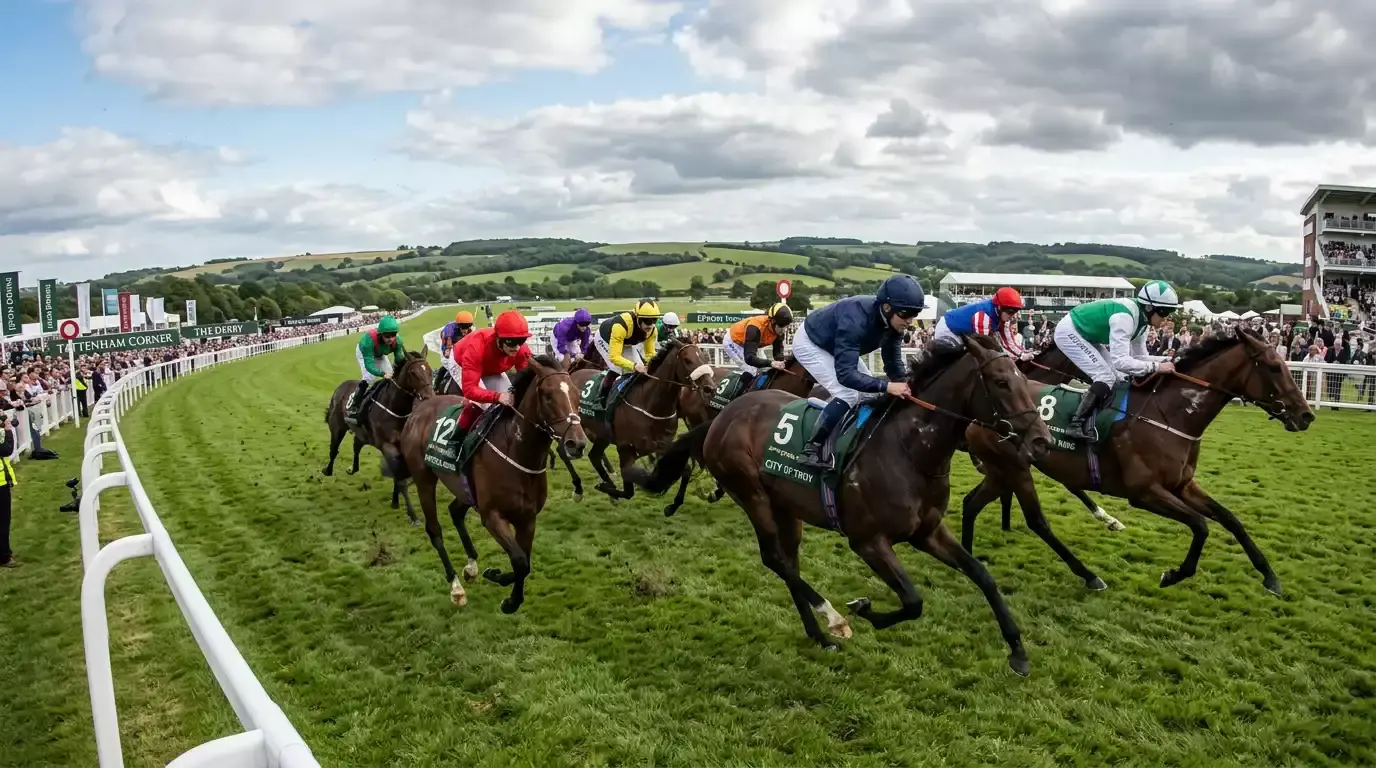
Epsom on Derby day feels like nowhere else in British racing. The funfair on the Downs side of the course, the crowd that stretches the length of the straight, the slightly chaotic atmosphere that mixes serious Flat racing connoisseurship with day-tripping casual punters — the meeting has a character that the more polished Royal Ascot week and the more reverent Cheltenham Festival both lack. And underneath all of that is a racecourse that demands more of its three-year-olds than any other Flat track in the country.
The Derby is the oldest of the five English Classic races, run since 1780, and the demands the course places on the horses contesting it are unlike anything else in their racing lives. Punters who treat the Derby as a normal Group-One race miss the point. The course is the story. The horses that handle it write the names that history remembers, and the ones that don’t, however talented elsewhere, leave the meeting without a Derby line on their record.
Epsom’s Course Profile: Camber, Gradients and Pace Dynamics
Epsom is shaped like nothing else in UK Flat racing. The Derby is run over one mile and four furlongs on a track that climbs sharply for the first half mile, runs along a high plateau, sweeps left-handed and downhill around Tattenham Corner, and then drops further before the final climb to the line. The camber across the straight is pronounced enough that horses can lose their footing on the lower side if they aren’t experienced at handling it. The course tests stamina, balance, jockey decision-making and basic athletic adaptability in proportions found nowhere else in the calendar.
The downhill section after the climb is the part of the course that catches inexperienced horses out. Three-year-olds asked to handle a serious downhill gradient at racing pace for the first time often lose their composure, run too freely, or fail to settle into the rhythm the race demands. The horses that win the Derby almost universally show evidence of having handled awkward tracks earlier in their careers — a trial at Lingfield, a strong run on undulating ground at York, or a previous good performance at a venue that tested their balance.
The pace dynamics produce their own pattern. Derby fields typically run an honest gallop for the first half of the race, with the early pace setters establishing position on the climb and the more patient horses settling in mid-field for the descent. Tattenham Corner is where the field stretches out — the leaders need to balance the turn while the chasers position themselves for the home straight. Horses out of position turning into the straight can find themselves with too much ground to recover on the rising finish.
The wider racing context matters because Epsom sits within a Flat season that includes far more aesthetically demanding venues. UK racecourse attendance reached 5.031 million in 2025, with 68% of UK racegoers across the season being casual or first-time attendees. The Derby meeting captures a substantial slice of that casual audience, particularly through the Investec connection’s marketing reach, but the racing itself rewards specialist analysis of the kind most casual punters don’t engage with. The mismatch between casual engagement and specialist demand is part of what makes Derby betting consistently interesting.
The economic contribution of UK racing — 4.1 billion pounds annually, supporting 85,000 jobs — sits visibly behind events like Derby day, where the breeding industry’s commercial interests, the racing industry’s heritage value, and the broader entertainment market all converge into a single afternoon’s racing. The race’s commercial significance ensures attention from the best Flat horses each generation, even as the wider Flat racing programme has seen pressure on prize money and competitive depth.
Three-Year-Old Form: Trial Races and What They Reveal
The Derby is the centrepiece of the three-year-old Classic season, and the trial races leading into it provide the form picture that prices the race in the months before the meeting. Different trials carry different signals, and the punter who reads them well has a substantial edge over the casual market.
The Dante Stakes at York, run over ten and a half furlongs in May, is the trial that has produced the most Derby winners across recent decades. The race is run on a galloping track over a distance close to the Derby trip, against a field of fellow Derby aspirants, and the form usually translates cleanly. A Dante winner that travels strongly and finishes well is one of the standard profiles of a serious Derby contender, and the prices on Dante winners tighten substantially in the run-up to Epsom.
The Chester Vase is the second key trial, run over Chester’s idiosyncratic round course with its sharp turns and short straight. Chester rewards horses with athletic ability and balance — qualities that translate particularly well to Epsom’s demanding geometry. The Vase’s form is sometimes underrated by markets that prefer the more conventional Dante profile, but Chester winners have produced multiple Derby champions and the trial deserves the weight serious punters give it.
The Lingfield Derby Trial is run over the actual Derby course distance of a mile and a half on a track that has some of Epsom’s undulations in compressed form. The trial doesn’t always produce the eventual Derby winner, but horses that perform well at Lingfield over the trip have demonstrated they can handle the specific demands the Derby will impose. Performance in the Lingfield Trial is one of the inputs that the markets discount less aggressively than it deserves.
The Newmarket and Newbury Classic trials, run over shorter distances earlier in the spring, provide stamina questions that the longer trials answer more definitively. A horse coming through these earlier trials needs to demonstrate it stays the Derby trip, and the stretching-out from a mile or ten furlongs to a mile and a half is one of the central form questions. Trainers’ patterns of campaign — which horses they target at which trials, which they bypass — encode information about how the yards view their horses’ stamina credentials.
The horse population context affects how trial form translates into Derby contention. The number of horses in training fell to 21,728 by the end of 2025, down 2.3% year-on-year, with the BHA projecting continued contraction in runner numbers through 2027. A smaller three-year-old population means a smaller competitive cohort for each year’s Classic season, which can compress the depth of Derby fields and amplify the importance of the top-end trial form among the few genuine contenders that do emerge.
Betting the Derby: Market Patterns and Value Windows
The Derby ante-post market opens in the autumn before the race and runs across nine months of trading. The early prices are typically generous on horses that look the right type but haven’t yet demonstrated the form to confirm their potential. The market compresses through the spring as the trials produce their results, with the strongest pre-Derby form usually emerging in late April and May.
The ante-post value windows on the Derby are most reliable in the late winter and early spring, before the major trials run. A horse identified as a likely Derby contender in February — based on its two-year-old form, its trainer’s pattern of campaigning, and its breeding profile — can often be taken at a price that the May market will not offer. The risk is the standard ante-post risk: the horse needs to actually run in the race for the bet to settle.
The day-of-race market on the Derby is sharp because of the volume of money flowing through it. The combination of recreational interest, professional engagement and international betting attention means the prices at the off reflect deep consideration of every available form signal. Value at the off is narrow and is more often found in the each-way market — where bookmakers typically pay three or four places at standard terms, with promotional enhanced terms occasionally pushing to five — than in the win-only market.
The trainer-and-yard dimension carries particular weight at Epsom because of the course’s specialised demands. Yards with strong historical Derby records have demonstrated they can prepare horses for the venue’s specific challenges. The leading Ballydoyle and Newmarket operations dominate the historical Derby record, and their entries each year deserve attention disproportionate to general Group-One handicapping form. A horse from a yard with a moderate Derby record, however impressive its trial form, is a different proposition from a horse from a yard with multiple Derby successes on its CV.
The strategic conclusion for Derby betting is that the race rewards punters who engage with it as a venue-specific challenge rather than as a generic Group-One contest. The horses that win the Derby are the ones suited to Epsom. The horses worth backing are the ones whose form profile suggests they can handle the unique demands. The casual approach — backing whatever’s running shortest, or backing whatever the racing media has profiled most aggressively in the run-up — produces results no better than chance over a long enough sample. The discipline of treating Epsom as a specialist puzzle rather than a generic championship is the analytical foundation. The closely related approach to the meeting’s broader Flat racing structural context is covered in my piece on navigating Royal Ascot’s five days of championship Flat racing, which discusses how venue-specific demands shape betting strategy across the wider Flat racing calendar.
