

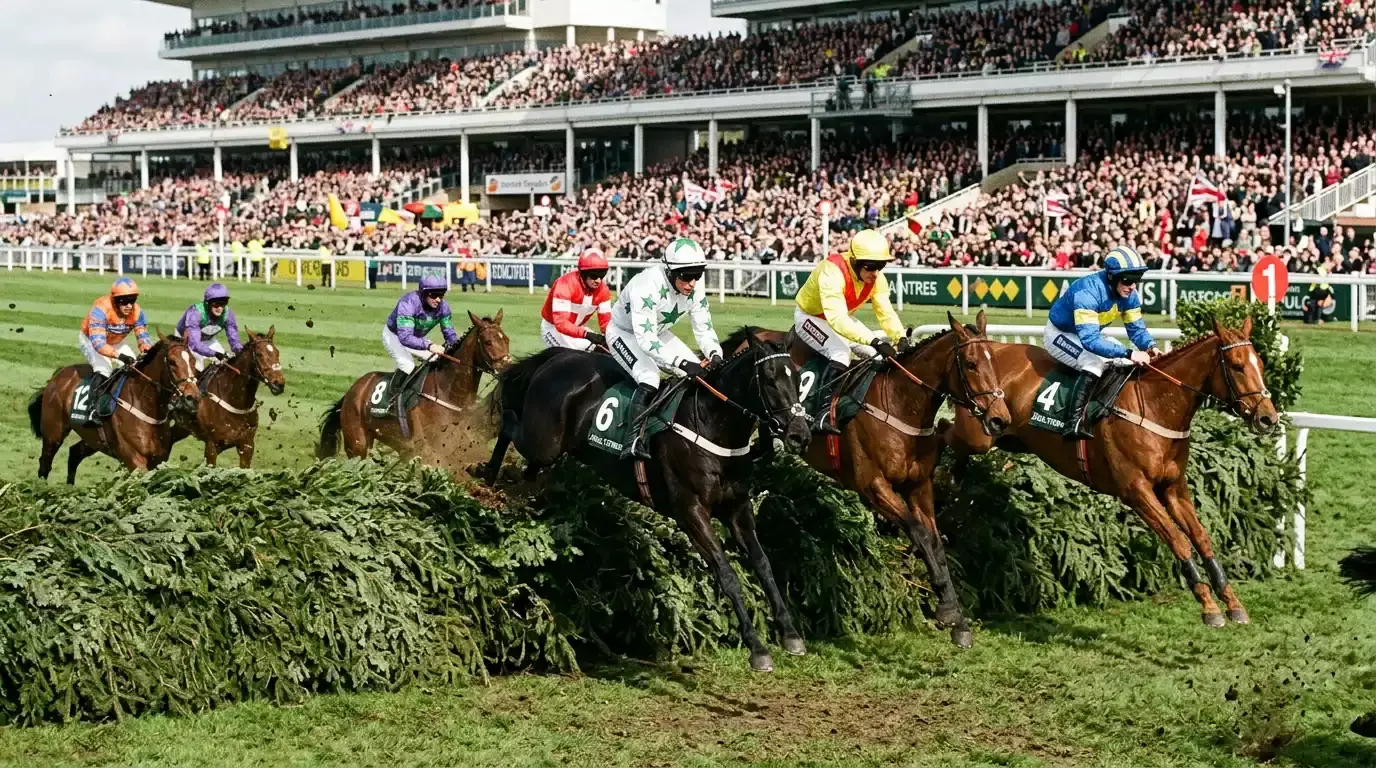
My mother bets on one horse race a year. It is, predictably, the Grand National. She picks her selection by some combination of the horse’s name, the jockey’s silks, and whether she likes the look of the trainer when they appear on the BBC’s preview. She has won more times than she’s lost across the past two decades, which is statistically improbable but, given how she picks, deeply consistent with what the Grand National actually is — a race designed to be accessible to the once-a-year bettor while remaining genuinely competitive for the serious punter.
Around 13 million people in the UK bet on the Grand National in a typical year — roughly a third of the adult population. The 2024 YouGov figures put the bet-rate among British adults at 19%, with the 2025 OLBG survey suggesting 17% planned to back the race. That’s an audience the size of which no other UK horse race comes close to matching. Understanding how to approach the National usefully means accepting that it’s a fundamentally different betting event from anything else on the calendar — and that the once-a-year bettor and the serious punter both need their own frameworks.
Because of the massive field size, placing an each-way bet on horse racing is often the smartest approach for this marathon event.
Aintree Factors: What Makes the Grand National Unique
The Grand National sits in a category of one. The race is run over four miles and two-and-a-half furlongs at Aintree, the longest distance in Grade-Three handicap chasing in the UK calendar. The field is forty runners — the largest standard field in Flat or jump racing — and the fences are the modified Aintree obstacles, lower and more forgiving than they were a generation ago but still distinctive in their construction and approach lines.
The economic scale is unique too. The race generates around 150 million pounds in betting turnover across UK and Ireland on race day alone, and the three-day Aintree fixture as a whole pushes that figure closer to 250 million. The Grand National produces around 700% more betting turnover than the Cheltenham Gold Cup, which is the closest comparable single race in the National Hunt calendar. The audience profile and the stake profile are both completely different from any other contest in the sport.
Nevin Truesdale, then the Chief Executive of The Jockey Club, captured the race’s dual position with characteristic precision: “It’s the main shop window of our sport, and it’s a race we need to preserve and protect, but it’s also a race that we need to maintain its acceptability to society.” That dual role — flagship event for the casual audience and serious test for committed punters — is what makes the betting approach so different from other meetings.
The forty-runner field changes the statistical landscape of the race fundamentally. In any other UK chase, the field rarely exceeds twenty runners and the favourite typically has a 25% or higher chance of winning on the prevailing market price. In the Grand National the favourite’s chance is rarely above 12% on price-implied probability, and the spread of plausible winners is much wider than in normal handicap chasing. A horse at 25/1 in the Grand National has a meaningful chance of winning. A horse at 25/1 in a standard handicap chase is genuinely a long shot.
The race’s distinctive features — the distance, the fences, the field size, the unique pace dynamics — mean that form from standard handicap chases doesn’t translate cleanly. The Grand National is a specialist’s race, even within the small population of horses that have the basic profile to contest it. Horses with previous Grand National form, even when that form is a respectable fall or a moderate finish, often outperform their nominal handicap ratings because they have demonstrated the fundamental capability to handle Aintree.
Key Selection Factors for the National: Weight, Age, Fencing Record
The four selection factors that experienced National punters weight heavily are weight, age, fencing record and stamina credentials. Each one carries genuinely predictive signal across the long history of the race.
Weight is the first because it’s the most quantitatively visible. The Grand National is a handicap, so weights are assigned by the BHA handicapper based on official ratings, with the top weight typically carrying around 11 stone 10 pounds and the bottom weight around 10 stone. The history of the race shows persistent over-performance from horses in the middle weight bands, roughly 10st 7lb to 11st 2lb. Top weights have won occasionally but at a strike rate noticeably below their market implied probability. The pattern likely reflects the cumulative effect of carrying additional weight over four-and-a-quarter miles.
Age matters because the National rewards experience and durability. Horses aged 8 to 11 dominate the winning history of the race; very young horses lack the chasing maturity to handle the fences cleanly, and older horses sometimes lack the speed to compete at the front through the closing two miles. The 9-and-10-year-old age bracket is the historical sweet spot for finding contenders.
Fencing record is where serious form analysis pays off. Aintree’s modified fences are not Cheltenham fences or Sandown fences — they have their own characteristics that some horses adapt to and others don’t. A horse with a strong jumping record in big-field handicaps elsewhere has demonstrated the basic competence. A horse with previous Aintree form, especially at the Grand National meeting itself, has demonstrated the specific competence. Jumping fragility — a record of falls or unseats — is genuinely disqualifying for the Grand National in a way it isn’t for shorter chases on smaller fields.
Stamina credentials are the final core factor. Four miles and two-and-a-half furlongs is a serious test, and horses without proven staying ability at three miles or more tend not to last the distance regardless of their class on shorter trips. The trial races that historically point to Grand National form — the Welsh National at Chepstow, the Scottish National, the Eider Chase, the Becher Chase at Aintree itself — produce a useful filter for genuine stayers. A horse without strong staying form on its CV is generally not a Grand National candidate, however attractive the prices appear.
Each-Way, Multiples and Sweep Stakes: Bet Types That Suit the National
The Grand National is the each-way punter’s natural home. The race typically pays five or six places at each-way odds at most major UK operators, with promotional enhanced terms pushing some operators to seven or even eight places in the days leading up to the race. The combination of a forty-runner field, a longest-priced field of contenders in UK racing, and the place-paying expansion creates an environment where each-way value is genuinely available across the field.
The place-only consideration matters because of the field size. Picking a horse to finish in the first five from a field of forty is mathematically a different exercise from picking a winner outright. Punters who treat the National as primarily a place-finding exercise rather than a winner-finding exercise often produce more sustainable long-term returns from the race than punters who concentrate on win-only stakes. The maths is straightforward: identifying a top-five finisher is a six-times easier task than identifying the winner, while the each-way place payout on long-priced horses is still substantial.
Get the ultimate edge for all major UK races right here at betsonhorseracing.
Sweep stakes are the dominant social betting format around the race. The office sweepstake, where participants pay a fixed amount for a randomly-allocated runner, captures a significant proportion of the casual audience and contributes to the race’s unique position in British social life. Sweep stakes are functionally a form of betting that bypasses the bookmaker entirely and pools the participation stakes directly. They’re not value-extracting structures for the participants — they’re entertainment structures — but they remain a meaningful slice of how the British public engages with the race.
Multiples — accumulators or smaller multiples combining the National with one or two other Aintree races — are popular but mathematically punishing structures for this race specifically. The compound probability of identifying the winner of a forty-runner handicap and any other horse on the same card is so low that even at the headline prices, the realistic chance of collecting is small. Punters who use multiples on the National generally treat them as recreational tickets rather than serious value plays.
For the casual punter coming to horse racing for the first time around the Grand National week, the foundational guide to placing the first bet covers the mechanics rather than the selection strategy. My breakdown of how to bet on horse racing for the first time walks through opening an account, reading a racecard and placing a slip step by step, which is the right starting point for anyone planning their first National bet without a long history of racing engagement behind them.
