

The first horse race I ever bet on was the 1995 Grand National. I was 12 years old, my grandfather backed me a 50p each-way bet on Royal Athlete at long odds, and the horse won. Beginners’ luck explains roughly nothing about that day except that someone took the trouble to walk me through what was happening. The form line in the paper. The way each-way worked. Why my grandfather had picked the horse rather than the favourite. That walking-through is the gap most beginner guides skip.
Across the UK adult population, 48% participate in some form of gambling in a typical month — that drops to 27% when you exclude the lottery — and the horse racing slice within that population sits at around 4%. That 4% is not a club. It’s a wide cross-section of people who happen to bet on racing, including a steady stream of complete beginners every year, particularly around the Grand National and Royal Ascot. This is a guide for one of those beginners.
Opening an Account and Verifying Your Identity
The first practical step is choosing a bookmaker and opening an account. You have to be 18 or older. You have to be using your own real identity, your own bank details, and your own address. The Gambling Commission’s licensing framework requires every UK operator to verify these things before any betting can happen, and the verification process has tightened steadily over the past five years.
The standard sign-up flow asks for full name, date of birth, address and contact details. Behind the scenes the operator checks these against a credit-reference database to confirm you exist and live where you say you do. For most users this happens automatically within seconds and the account is fully usable straight away. For some users — particularly anyone who has moved house recently, who has minimal credit footprint, or whose name spelling on the betting account doesn’t exactly match the credit-record version — the verification kicks out and requires manual document upload. A passport or driving licence photo, plus a utility bill or bank statement showing the registered address, will normally resolve it.
Once your account is open, the affordability check threshold is worth knowing about from day one. The Gambling Commission tightened the threshold in early 2025 — affordability checks now trigger at 150 pounds in net monthly deposits, down from a previous 500-pound benchmark. If your deposits in a calendar month total more than 150 pounds, the operator may request documentation showing the activity is affordable for you. The exact triggers vary by operator and by the wider risk picture of your account, but knowing the threshold helps you understand why an operator might ask for documentation that the betting industry didn’t routinely request a few years ago.
The other thing every new account needs is a deposit method. Debit card is the most universal option and is the default at every major UK operator. Bank transfer is available but slower. PayPal and similar e-wallets are widely supported. Credit cards are no longer permitted for UK gambling deposits since the Gambling Commission’s 2020 prohibition, so any first-deposit prompts that look like they’re asking for a credit card are actually asking for debit only.
Reading a Racecard: Runner, Form, Trainer, Jockey, Draw
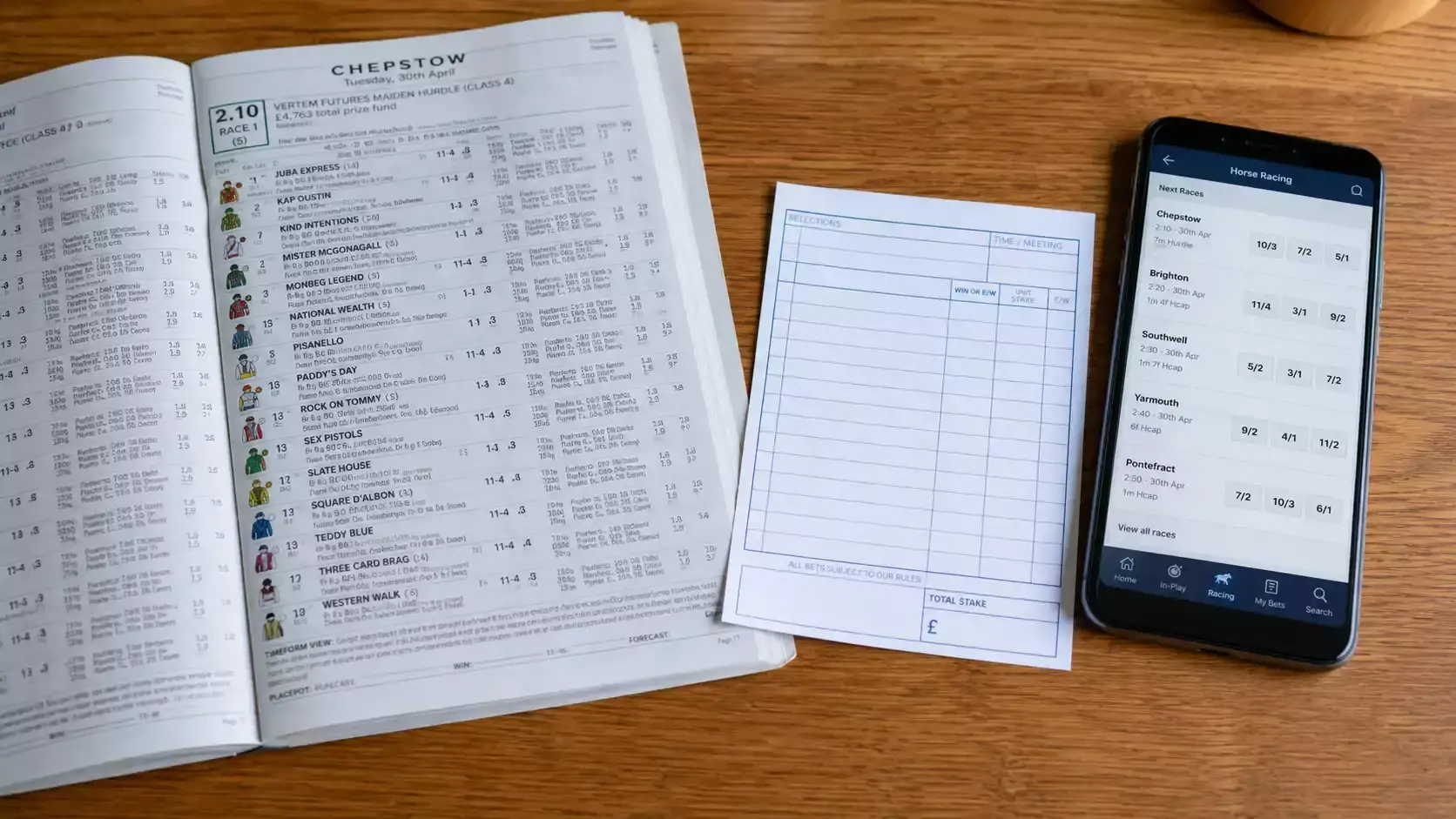
Before you place your first bet you need to know how to read what’s in front of you. A racecard for a UK horse race contains a remarkable amount of information packed into a small space, and the conventions are consistent enough across publishers that learning one means understanding all of them.
The runner number — that’s the saddlecloth number worn by the horse — is the leftmost column on most racecards. Next to it is the draw, which only applies to Flat races and tells you which starting stall the horse will break from. In handicap sprints especially the draw can be a serious factor in performance because of track geometry and racing line preferences.
The horse’s name follows, usually with the trainer’s name beneath. Next to those is the form line — a string of digits and letters representing the horse’s recent runs in reverse chronological order. A figure 1 means a win in that race. Digits 2 through 9 mean a finishing position. A figure 0 means finished tenth or worse. Letters carry specific meanings: F is a fall, U is unseated rider, P is pulled up, R is refused. A hyphen separates seasons or campaigns; an oblique stroke marks a longer break. A horse showing form of 4-321 has had a break followed by a fourth, a third and a second-most-recent run finishing second, and a most-recent run that won.
Weight is shown next — the imposed weight the horse will carry, expressed in stones and pounds for UK racing. Higher weights generally indicate higher official ratings and stronger horses on form, particularly in handicap races where the weights are explicitly assigned to equalise the field.
The jockey is named alongside the weight, and the official rating — the OR — is shown for handicap entries to give you a sense of the class assessment behind the weight allocation. Course-and-distance form is often abbreviated to C, D or CD next to the horse’s record, telling you whether the runner has won previously at the same course, over the same distance, or both.
Reading this for the first time feels overwhelming. Reading it for the tenth time becomes fluid. The discipline that helps most is to start by ignoring everything except the form line and the jockey — those two columns tell you most of what matters for a beginner’s first bets, and adding the other dimensions gradually as you get comfortable.
Placing Your First Bet: From Selection to Slip
You’ve picked a horse. Time to actually put the bet on. The online slip-builder is more forgiving than the betting-shop counter, but the underlying decisions are the same in both places.
Step one is the bet type. The two most common first bets are the straight win and the each-way. A straight win means your horse has to finish first for the bet to pay. An each-way is two bets stacked together — one half on the horse to win, one half on the horse to be placed (typically in the first three or four positions, depending on field size and race conditions). The total stake on an each-way is double the unit stake because you’re effectively placing two separate bets. A 5-pound each-way is a 10-pound total commitment.
Step two is the stake. UK operators set minimum stakes for online betting that are usually very low — often just 10p per line for many markets. The maximum is constrained by your account limits and the operator’s risk position on the specific market. For a first bet, pick a stake you would be entirely relaxed about losing — that’s the right amount.
Step three is the price. You’ll see odds displayed in fractional format by default at most UK operators — something like 9/2 or 7/1. Some operators let you toggle to decimal odds if you find that easier to read. Either format expresses the same underlying probability and return per unit stake. The slip will show you the projected return if your bet wins, including the stake you’ll get back.
Nevin Truesdale, the Chief Executive of The Jockey Club, captured something true about why people come to the sport in the first place when he described the changing relationship between racing and its audience: “Sport is changing, sport is evolving. Sport is evolving because society’s expectations of sport are changing, and the Grand National is right in the centre of that.” That centrality is why the National is the entry point for many first-time bettors — and why placing a small bet on a major race is one of the cleanest introductions to how the whole system actually feels.
Step four is confirmation. Most slips ask you to confirm before the bet is placed. Take the half-second to actually look at the slip rather than just clicking through. Check the horse name, the stake, the bet type and the price. Mistakes at this stage are easy to make and almost impossible to reverse once the bet has been accepted.
What Happens After the Race: Returns, Dead Heats, Objections
The race runs. The result comes in. Your bet either wins or loses, in most cases. The “in most cases” is what new bettors need to know about.
If your horse wins outright, the winnings — including the returned stake — credit to your account automatically once the result is declared official. The official declaration typically happens within a couple of minutes of the race finishing, after the weighing-in process is complete and the stewards have confirmed there are no objections to investigate. Funds are usually withdrawable straight away on a verified account.
Dead heats — where two or more horses cross the line in a finish too close to separate — are settled on a divided-stake basis. If your horse dead-heats with another for first place, your win bet pays out at half the standard stake at the same odds. This is sometimes mistakenly called “half winnings” but the technically correct framing is that the stake is halved on the dead-heating result.
Objections and stewards’ inquiries can change a result after the race has finished. A horse that crossed the line first can be demoted to second or worse if the stewards rule there has been interference. Bets are settled on the official finishing positions after any inquiry resolves, not on the order across the line. Inquiries usually resolve within ten minutes of the race; in rare cases involving doping or formal protest, settlement can be delayed for longer.
The final thing to know is that placing a first bet successfully doesn’t mean you’ve learned to bet successfully. The first bet is the entry point, not the destination. Once the mechanics are familiar, the real learning is in understanding how prices reflect probabilities — and that conversation belongs in the wider piece on how fractional and decimal horse racing odds actually work.
