

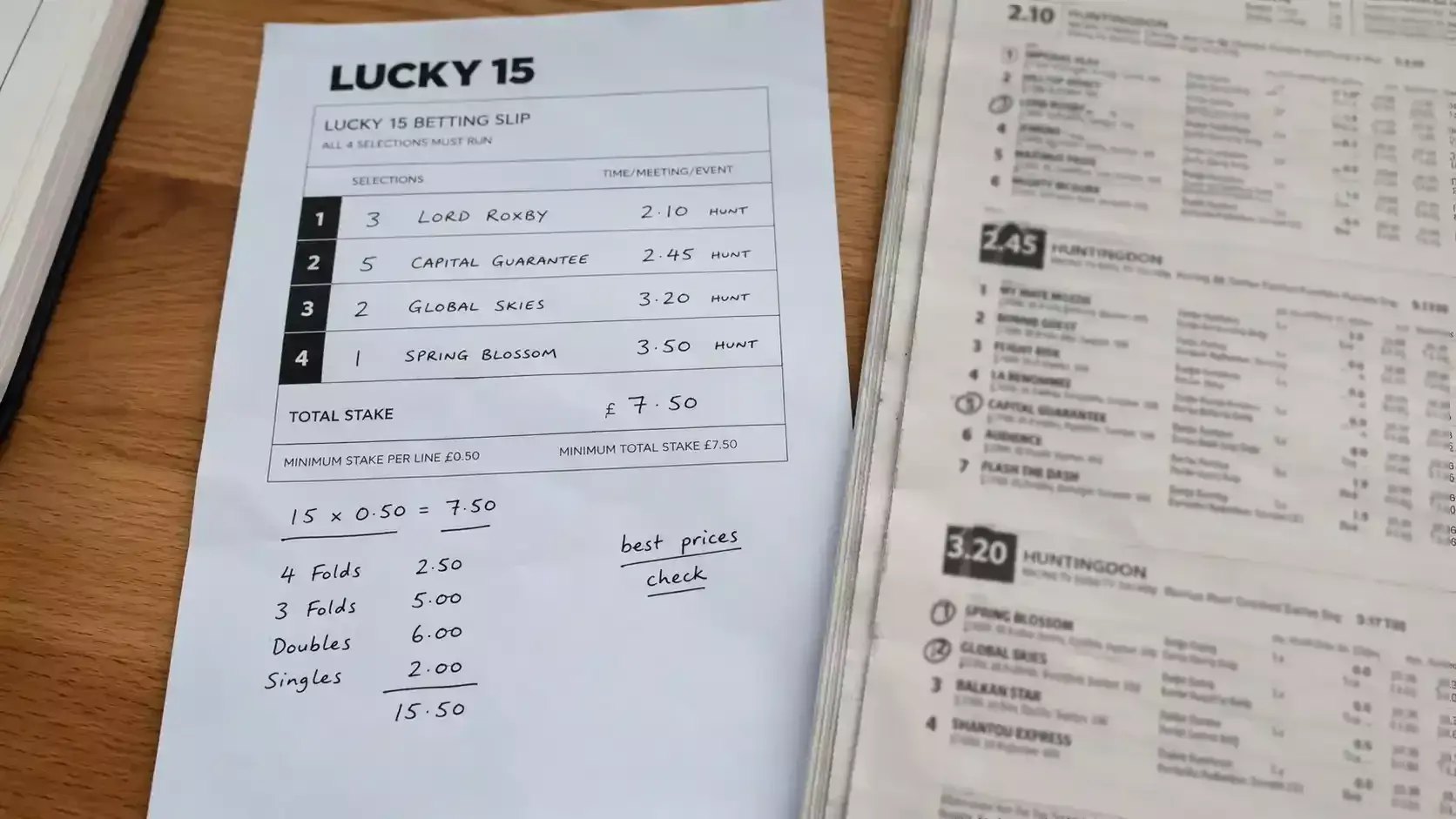
My father-in-law has been placing the same one-pound Lucky 15 every Saturday afternoon for about thirty years. He doesn’t really know why he switched from a Yankee somewhere in the late nineties, except that he liked having singles in the bet so he could feel like he’d won something most weeks. He’s correct that he wins something most weeks. He’s incorrect, on a long enough timeline, about whether the Lucky 15 has been good to him versus the alternatives.
The Lucky 15 is one of the most popular bet structures in UK horse racing, and its appeal is entirely understandable. Four selections, 15 bets in one — singles, doubles, trebles and a four-fold. Even one winner returns something. Two winners typically cover the stake on shorter prices. Three or four winners can produce dramatic returns. But the underlying value proposition only works if you understand the cost structure and the situations where it genuinely outperforms simpler alternatives.
The 15-Bet Structure: Singles, Doubles, Trebles and a Four-Fold
The mechanics are simpler than the name suggests. You pick four horses. The bookmaker constructs 15 separate wagers from those four selections. Four singles — one on each horse. Six doubles — every possible pairing of your four. Four trebles — every possible group of three. One four-fold accumulator covering all four selections together.
The maths is the combinatorial sum: 4 plus 6 plus 4 plus 1 equals 15. There’s no hidden structure. The 15 isn’t a marketing number — it’s the literal count of every singles-plus-multiple combination that can be drawn from four selections without repeating any horse within a multiple.
Each of those 15 wagers settles independently. If horse A wins, the single on A pays out. If horses A and B both win, the double on A-and-B pays out, in addition to the individual singles. If horses A, B and C all win, the relevant treble pays as well. And so on. The structure means the returns escalate non-linearly with the number of winning legs — one winner pays modestly, four winners pay extraordinarily.
The position of Lucky 15 within the wider UK betting market makes sense in context. Multiples as a category capture roughly 10% of UK horse racing betting activity, and within that category the Lucky 15 is one of the most-placed structures because it sits in a comfortable middle ground between pure accumulators and individual singles. Win-only bets dominate the market at 36% and each-way at 22%, but the Lucky 15 represents the largest share of the genuine multi-selection territory.
The reason Lucky 15 outperforms a pure four-fold accumulator on most slips is that it pays partial credit. The pure four-fold on the same four horses requires every leg to land for any return. The Lucky 15 returns something even on a single winner. The reason a pure four-fold can outperform the Lucky 15 on the same four horses, when every leg lands, is that the four-fold concentrates all the stake on the highest-paying line. Splitting the stake across 15 lines spreads risk but also caps the maximum return.
Cost Calculation and Return Scenarios
Here’s where punters get caught out at the betting counter or on the slip-builder online. The advertised “unit stake” of a Lucky 15 refers to the stake per line, not the total stake. A one-pound Lucky 15 costs 15 pounds. A two-pound Lucky 15 costs 30. A fiver per line is a 75-pound bet. This catches first-time placers more than any other detail of the structure.
Once the cost is clear, the return scenarios are worth walking through with real numbers. Take four selections, all at 3/1, and assume one winner. The single on the winning horse pays 4 pounds for every pound staked — including the returned stake — so on a one-pound Lucky 15 you collect 4 pounds. You’ve spent 15. The single winner returns less than a third of the outlay.
Two winners at 3/1 each. Each single pays 4, so 8 pounds from the two singles. One double connects, paying 16 pounds (4 times 4 from the doubled stake structure). Total return 24 pounds on a 15-pound outlay. The two-winner case has cleared the stake and produced modest profit.
Three winners at 3/1. Three singles pay 12 pounds combined. Three doubles connect, each paying 16, for 48. One treble connects, paying 64 (4 times 4 times 4). Total return 124 pounds on 15. The three-winner case is where the Lucky 15 starts to look properly attractive.
Four winners at 3/1. Four singles pay 16. Six doubles each pay 16, for 96. Four trebles each pay 64, for 256. One four-fold pays 256. Total return 624 pounds on 15. The four-winner case is the Lucky 15’s reason to exist.
Adjust those underlying odds upwards and the four-winner returns climb extraordinarily — four winners at 5/1 each on a one-pound Lucky 15 returns 2,592 pounds. Adjust them downwards to 6/4 each and the four-winner return collapses to 161 pounds on 15. The structure rewards strong prices on every leg with non-linear returns. Build a Lucky 15 from four short favourites and you’re effectively paying 15 pounds for a maximum realistic return in the low hundreds.
The UK market structure underneath all of this matters. Multiple bets account for around 10% of the overall horse racing betting market, and Lucky 15 places sit within that segment. The bookmakers’ margins on Lucky 15s are designed assuming a typical user picks selections in a price range where one or two winners is the modal outcome — which is to say, the structure is calibrated to pay out partially most weeks and to pay out dramatically rarely.
Consolation Bonuses and All-Losers Protection
This is the feature that genuinely separates the Lucky 15 from competing structures, and it’s where most operators differentiate their offering. The two standard consolation features are the single-winner bonus and the all-winners bonus.
The single-winner bonus typically doubles the odds on any single winning selection if it’s the only winning leg in the entire bet. So one winner at 3/1 in a four-selection Lucky 15 pays at 6/1 instead. On the one-pound example above, the single winner returns 7 pounds rather than 4 — still less than the 15-pound outlay, but a meaningful uplift on the otherwise grim scenario.
The all-winners bonus does the opposite end — if all four selections win, the operator typically adds a percentage uplift to the total winnings. Common figures are 10% or 20%. On the four-winners-at-3/1 example above, a 10% bonus turns the 624-pound return into 686. The exact terms vary by operator and the bonus percentages have crept lower over the past decade, but the feature still exists at most major UK firms.
The market for these consolation features has tightened. Industry pricing data shows just how concentrated the UK sports betting market is online — William Hill and bet365 between them captured a majority of paid search clicks in the sports betting category in early 2026, with William Hill alone taking 37.83%. That kind of share concentration means a smaller number of operators are setting the de-facto market terms for what Lucky 15 consolation looks like, and the trajectory has been gentle erosion rather than enhancement.
A handful of UK operators run a more generous variant — single-winner odds trebled rather than doubled, or all-winners bonuses at higher percentages. These offers come and go with promotional cycles and tend not to last. The base structure — doubled odds on single winner, percentage uplift on all winners — is the safest assumption when comparing Lucky 15 returns across operators.
The strategic question is whether the Lucky 15 structure makes sense for your betting style at all. If you’re picking four horses you’d be confident enough to back as singles, the singles route concentrates stake and avoids the multiplier overhead. If you’re picking four horses for a four-fold accumulator you’d be willing to take, the four-fold concentrates everything in the maximum-return line. The Lucky 15 makes sense specifically when you want exposure to partial outcomes — when you’d be genuinely pleased to collect modest returns on one or two winners rather than wait for the full set. For a wider look at how multi-leg structures compare against each other, my breakdown of how to build and manage horse racing accumulators covers the question of where multi-selection bets earn their place in a betting portfolio.
